Procrastination Is the Most Expensive Thing You Own
I'm a terrible procrastinator.
I'm not saying that to sound relatable. It's just true. Ask anyone who works with me. I'm also a perfectionist, which is a delightful combination for everyone around me, because it means I can put something off and then insist it's not ready yet.
Here's what took me far too long to learn about procrastination in business. It doesn't feel expensive. It feels like nothing. You didn't spend anything today. You didn't lose anything today. You just didn't do the thing.
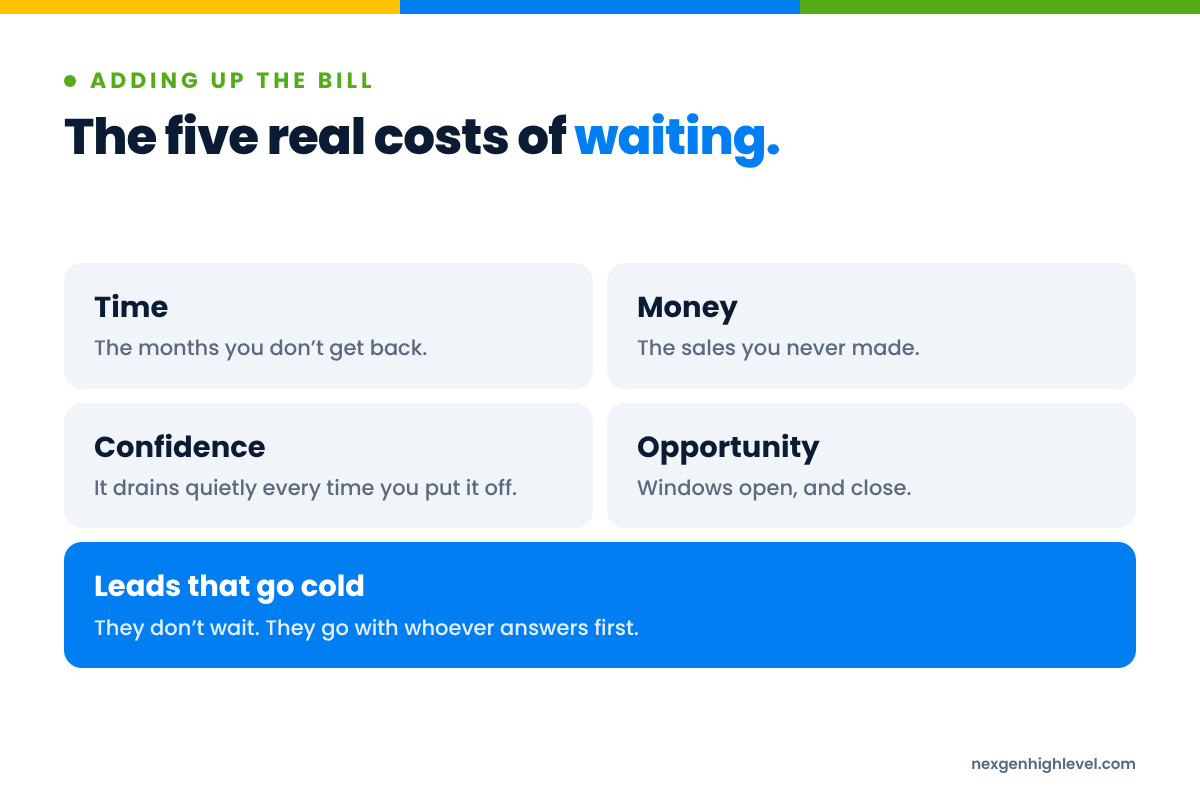
But nothing is free. The waiting gets paid for somewhere. In time you don't get back. In money you never made. In confidence that quietly drains away. In the customer who went with someone else because they called first.
You never get an invoice for it. That's what makes it so dangerous.
So let's add it up properly. And then let's talk about how to stop paying it.
Why procrastination in business costs more than you think
When you procrastinate at home, the cost is usually small and obvious. The garden gets a bit wilder. The tax return becomes a last-minute panic. Annoying, but contained.
In business, it compounds.
Every week you don't launch is a week you don't learn. Every week you don't learn is a week your next decision is made with the same old guesses. And every week of guesses is a week a competitor who did launch is learning faster than you.
That's the bit people miss. The cost isn't the one week. It's the gap that widens behind it.
Look at the people starting things right now. In the US, business applications for September 2026 were 534,947, seasonally adjusted, according to the Census Bureau. That's over half a million people in a single month putting their hand up and saying "I'm doing this."
But an application isn't a business. It's an intention with paperwork attached.
Starting is common. Following through is rarer. And the difference between the two is very often just procrastination wearing a sensible jacket.
It rarely looks like procrastination
That's the other problem. In business, procrastination is good at disguising itself.
It looks like research. It looks like "getting the brand right". It looks like one more course, one more webinar, one more look at the competition. It looks like reorganising the folders in your HighLevel account for the fourth time instead of sending the first email.
But ask yourself honestly. Is this moving me towards a customer? Or is it moving me away from the scary thing?
Busy isn't the same as moving.
The five real costs of waiting
Let's put it on the table. When I look back at the things I've put off in my own career, the bill always came in five currencies.
1. Time
This is the obvious one, and somehow the one we're worst at counting.
Picture two people opening a cleaning business on the same day. Same town, same skills, same budget. One spends three months perfecting the website, the price list and the brochure. The other gets a simple page up in a week and starts knocking on doors.
Three months later, the first person launches a lovely website. The second has had thirty conversations, learned that nobody in the area cares about the "eco" angle but everyone cares about reliability, rewritten the offer twice and has a handful of regular customers.
Who's further ahead? It's not even close.
Time spent waiting isn't neutral time. It's time your competitor is spending learning.
2. Money
Some of the money cost is direct. Software and subscriptions ticking over while you "get ready".
But the bigger cost is the money you never see. The revenue from the customers you would have had if you'd started three months earlier. That money doesn't show up in any report. It just isn't there.
In the Federal Reserve's 2024 Small Business Credit Survey of employer firms, 51% reported uneven cash flow and 48% reported weak sales in the previous 12 months. Only 6% said they hadn't faced any financial challenges at all. (It's a convenience sample, so treat it as a strong signal rather than a census.)
When cash is that tight for that many businesses, the months you spend not selling are months you genuinely can't afford.
3. Confidence
This one sneaks up on you.
You'd think waiting would make you more confident. More time to prepare, more time to get it right. In my experience it does the opposite.
The longer you put something off, the bigger it gets in your head. A phone call becomes a Big Phone Call. A launch becomes The Launch. Every day you don't do it, you're quietly teaching yourself that it's something to be afraid of.
Confidence doesn't come from preparation. It comes from evidence. From doing the thing, surviving it, and noticing that you survived it.
You can't think your way into confidence. You have to act your way into it.
4. Opportunity
Markets move. Windows open and close. The customer who's ready to buy this month might sign with someone else next month and be locked in for two years.
Recruitment taught me this early. Good people didn't wait around for you, and neither did the clients hiring them. Nobody rang you to say "we were going to work with you, but you took too long." They just went quiet.
That's how missed opportunity works. It doesn't announce itself. It just doesn't happen.
5. Leads that go cold
And this is the one that hurts most, because it's the most measurable.
Someone fills in your form. They're interested right now. They've got the problem right now. They're probably filling in two or three other forms right now too.
Then they wait. An hour. A day. Three days. By the time you call, they've either solved it, gone with someone else or forgotten they ever asked.
Harvard Business Review covered this years ago in "The Short Life of Online Sales Leads" by James Oldroyd, Kristina McElheran and David Elkington. The summary line is simple: "most companies are not responding nearly fast enough."
An earlier study by InsideSales.com with James Oldroyd, then at MIT, went further. It reported that the odds of contacting a lead dropped dramatically if you waited 30 minutes rather than 5. It's a vendor co-authored study, not a peer-reviewed paper, so I wouldn't hang a business plan on the exact multiplier. But I don't think anyone who's ever run a sales team would argue with the direction.
Slow follow-up is procrastination with a price tag. You just don't see the price, because the lead doesn't tell you why they went elsewhere.
Adding up the bill
Here's how I think about it.
| What you put off | What it looks like | What it actually costs |
|---|---|---|
| Launching | "It's not ready yet" | Months of learning you'll never get back |
| Selling | "I'll start outreach once the website's done" | Revenue that simply never exists |
| The hard conversation | "I'll raise it next week" | A small problem growing into a big one |
| Follow-up | "I'll call them tomorrow" | The lead who went with someone faster |
| Deciding | "I need more information" | Confidence, and a competitor's head start |
None of these feel like spending. All of them are.
Why we procrastinate (and why it isn't laziness)
I want to be fair to procrastinators here, partly because I am one.
It's tempting to call procrastination a character flaw. I don't think that's true, and neither does the research.
In 2007, Piers Steel published a big review of the research in Psychological Bulletin, "The nature of procrastination". It pulled together findings from 691 correlations across many earlier studies. It estimated that 80% to 95% of college students procrastinate, and that procrastination is "chronically affecting some 15-20% of adults". It also noted that its prevalence "appears to be growing".
So if you procrastinate, you're in very large company. That's not an excuse. It's just a reminder that you're not uniquely broken.
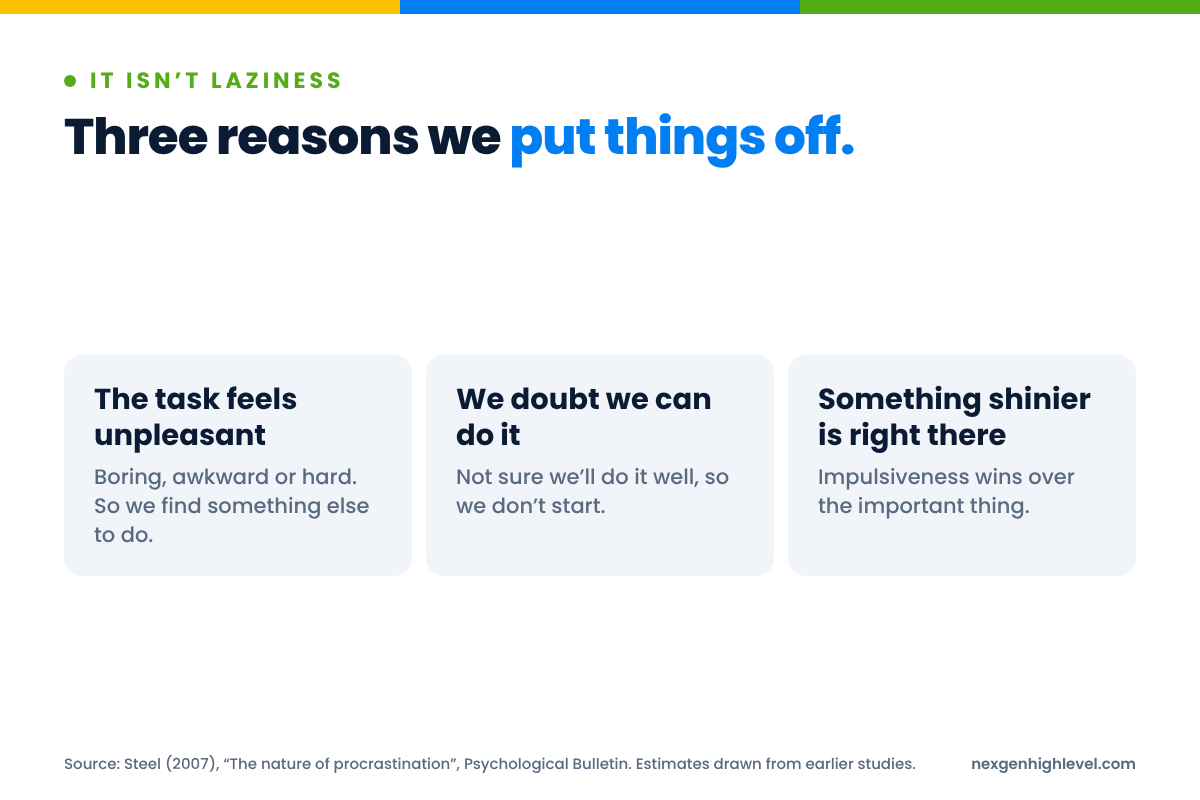
What I find most useful in Steel's work isn't the size of the problem. It's what predicts it. Among the strongest predictors were three things.
Task aversiveness: the thing is unpleasant
We put off what we don't enjoy. Obvious, really. Nobody procrastinates on eating pizza.
In business, the unpleasant tasks are often the important ones. Cold outreach. Asking for the sale. Chasing an invoice. Recording a video of yourself. Writing the first page of something with no idea what goes on it.
I saw this first-hand in my agency days. We worked with private medical practices, mostly in the US. Technically, we were very good: ads, funnels, follow-up, CRM. But the clinicians wouldn't supply content. We'd get nothing, or two stock photos and a 14-second video filmed from what looked like six miles away.
They weren't lazy. They hadn't gone into healthcare to be content creators. Put a camera in front of them and they froze.
So we built an app with prompts that removed the blank page and the fear of the camera. And it worked. Not because it made better content, but because it made the task less horrible to start.
We weren't really solving a content-production problem. We were solving a human-friction problem.
Keep that in your back pocket. We'll come back to it.
Self-efficacy: you're not sure you can do it
If you don't believe you can do something well, you'll find reasons not to start. Starting means finding out. Not starting means you can keep the comfortable maybe.
This is huge when you're starting a business. You're doing a dozen things you've never done before. Pricing. Sales. Marketing. Hiring. Systems. Every single one has a little voice attached saying "you don't really know what you're doing here."
Nobody has it all figured out. Not the person with half a million followers, not the person posting screenshots of their revenue, not me. Everyone is working with incomplete information. Some people are just more comfortable deciding anyway.
Back yourself. Six weeks to find out beats six months of wondering.
Impulsiveness: something shinier is right there
The third predictor is impulsiveness. The pull of the more immediately rewarding thing.
I have ADHD, so I know this one personally. I can be all over the place at times, chasing five interesting things at once, and then hyper-focused on one for hours. The trouble is that the thing I'm hyper-focused on isn't always the thing that matters most.
In business, the shiny thing is everywhere. A new AI tool. A new channel. Your phone, buzzing every ninety seconds.
Impulsiveness doesn't feel like avoidance. It feels like enthusiasm. That's what makes it so convincing.
Put the three together
Look at those three predictors side by side and something useful jumps out.
- The task feels unpleasant.
- You're not sure you can do it well.
- Something easier and more fun is sitting right next to it.
That's not a description of a lazy person. That's a description of almost every important first step in a new business.
Which means the fix isn't "try harder" or "be more disciplined". The fix is to change the task. Make it less unpleasant, make it more doable, and make it the most obvious thing in front of you.
It's not a willpower problem. It's a design problem.
The three stuck personalities and how each one delays
Over the years I've noticed that people get stuck less because of their industry and more because of their personality. I think of three types. I see myself in all three, which is either very self-aware or quite worrying.
The Tinkerer
The Tinkerer is buried in the tools. They're in build mode, play mode, tweak mode. The workflow is nearly perfect. The pipeline stages have been renamed four times. The email template has had its font changed again.
What they haven't done is send it to a customer.
The Tinkerer's procrastination looks like productivity, which is why it's so hard to spot. If this is you, ask yourself one question every day: what have I put in front of a real customer this week?
The Rusher
You'd think the Rusher was the cure for procrastination. They get to market fast. They ship.
But the Rusher procrastinates too. Just on different things. They put off the boring foundations: the follow-up, the onboarding, the numbers. So they launch quickly and then leak customers through the gaps they didn't fix.
I've been the Rusher. I grew my recruitment business aggressively, with heavy overheads, and never imagined the world could simply stop. Then Covid arrived. Furlough covered salaries, but not the rent, property taxes, leases or software licences, and no supplier cut me a break. I had to close it and let good people go. It was the hardest business decision of my life.
That taught me something I still live by. Walk before you run. And even when you're ready to run, keep walking for a little bit longer.
Speed isn't the opposite of procrastination. Doing the right next thing is.
The Magic-Bullet Believer
The Magic-Bullet Believer is always one tool away from success. The next app. The next platform. The next course. They buy it, try it for a day and move on.
We've seen people install one of our apps and uninstall it the next day. Go figure.
This is procrastination dressed up as progress. Buying a tool feels like action. Learning to use one properly is the actual action, and it's slower and less exciting, so it gets put off.
What all three need
My advice to all three is the same.
Know your goal. Plan properly. Set up properly. Understand properly. Then go for it.
Notice what that isn't. It isn't "plan forever". The planning is in service of the going. If you've ever found yourself polishing a plan instead of starting, I've written about the world-class planner who never launches, because planning can become a very comfortable hiding place.
And the research supports a short plan, not a long one. Francis Greene at the University of Edinburgh Business School found that entrepreneurs who write formal plans are 16% more likely to achieve viability. But planning for much longer than a few months didn't help, because, as the research put it, "the information goes stale".
Plan enough to start well. Then start.
Shrink the first step
So if procrastination is a design problem, how do you redesign the task?
This is the most useful thing I know about beating procrastination in business, and it's almost embarrassingly simple.
Make the first step smaller.
Not the goal. The goal can stay big. Just the first step.
Big first steps invite procrastination
"Launch my business" is not a task. It's a fog. Your brain looks at it, can't see where it starts and goes off to check email instead.
"Build my marketing system" is the same. Where do you even begin? The website? The forms? The follow-up emails? The booking calendar? The review requests?
Every one of Steel's three predictors gets worse when the first step is big. It feels heavier, you feel less capable, and anything shiny beats a fog.
Small first steps get done
Now try this instead.
- Not "launch the business". Write down the one thing you sell and who it's for. Today.
- Not "do outreach". Message five people you already know and ask them one question.
- Not "build a website". Put up one page that says what you do and how to contact you.
- Not "record videos". Record one, sixty seconds long, answering a question a customer actually asked you.
Each of those is something you could start in the next ten minutes. That's the test. If you can't start it in ten minutes, it's not a first step yet. Break it down again.
Borrow the bit you'd otherwise build
Here's the other way to shrink the first step, and it's the one I wish I'd understood twenty years ago.
Don't build what already exists.
A blank page is the most procrastination-friendly object in the world. It's unpleasant, it makes you doubt yourself and it's easy to walk away from. That's exactly why the prompts worked for those clinicians. We didn't give them more willpower. We took away the blank page.
The same applies to starting a business. You don't have to invent your sales process, your follow-up sequence or your onboarding from nothing. Plenty of people have worked those things out before you. Templates, checklists, proven processes, systems someone else has already tested. Borrow them, then make them yours.
That's not cheating. It's what sensible people have always done. I've written more about why you don't have to build your business from scratch, but the short version is this: the less you have to invent, the less there is to put off.
It's the thinking behind our HighLevel Snapshots, too. A Snapshot is a complete business system for a particular niche, already connected around the client journey, that you load into your HighLevel account and make your own. Clients have used them to skip months, if not years, of trial and error building a system. It doesn't replace a good offer or understanding your customer. Nothing does. But it turns "build everything" into "make this yours", which is a much smaller first step.
Start from something, not from nothing.
Where procrastination hides in your HighLevel account
I want to come back to the leads that go cold, because this is where procrastination does its quietest damage. And it's where a bit of leverage makes the biggest difference.
Most follow-up doesn't fail because people don't care. It fails because "I'll call them tomorrow" relies on tomorrow-you having the time, the memory and the energy. Tomorrow-you is busy. Tomorrow-you has a client emergency. Tomorrow-you forgets.
My memory is terrible. I remember useless facts from years ago and forget what I was told yesterday. So I don't trust tomorrow-me with anything important.
Let the system do the remembering
This is where HighLevel earns its place. Not because technology is magic, but because it removes the decisions you'd otherwise put off.
- When someone fills in a form, a Workflow can send an immediate, personal-sounding reply by email and SMS, so the first response never waits for you.
- Tags and smart lists show you exactly who's waiting on you, so nobody slips into a forgotten corner.
- Opportunities and pipelines make stalled conversations visible. If a deal has sat in one stage for two weeks, you can see it.
- Calendars with confirmations and reminders stop booked calls going quiet.
- Conversations keeps every message in one inbox, so "where did they reply?" stops being a reason to delay.
None of that replaces you. People buy from people. It just means the first, fastest, most easily-forgotten steps happen without anyone having to remember them.
If speed to lead matters in your business (and I've yet to find one where it doesn't), it's worth reading how we think about responding to WhatsApp leads quickly, and why automation belongs in a business from day one rather than year three.
But don't automate the procrastination
A word of warning, because I've seen it happen.
Technology is leverage, not strategy. Leverage multiplies whatever is underneath it. If what's underneath is a weak offer or a message nobody cares about, automation just helps you procrastinate on fixing those, while feeling very busy and technical.
Human first. Who is this person and what do they actually want? Strategy second. What's the offer, the message, the journey? Leverage third. Then let HighLevel do the remembering.
Human. Strategy. Leverage. In that order.
If you multiply zero by a thousand, you've still got zero.
A practical way to break procrastination in business
Let me give you something to actually use. Not a system to admire. Something to do this week.
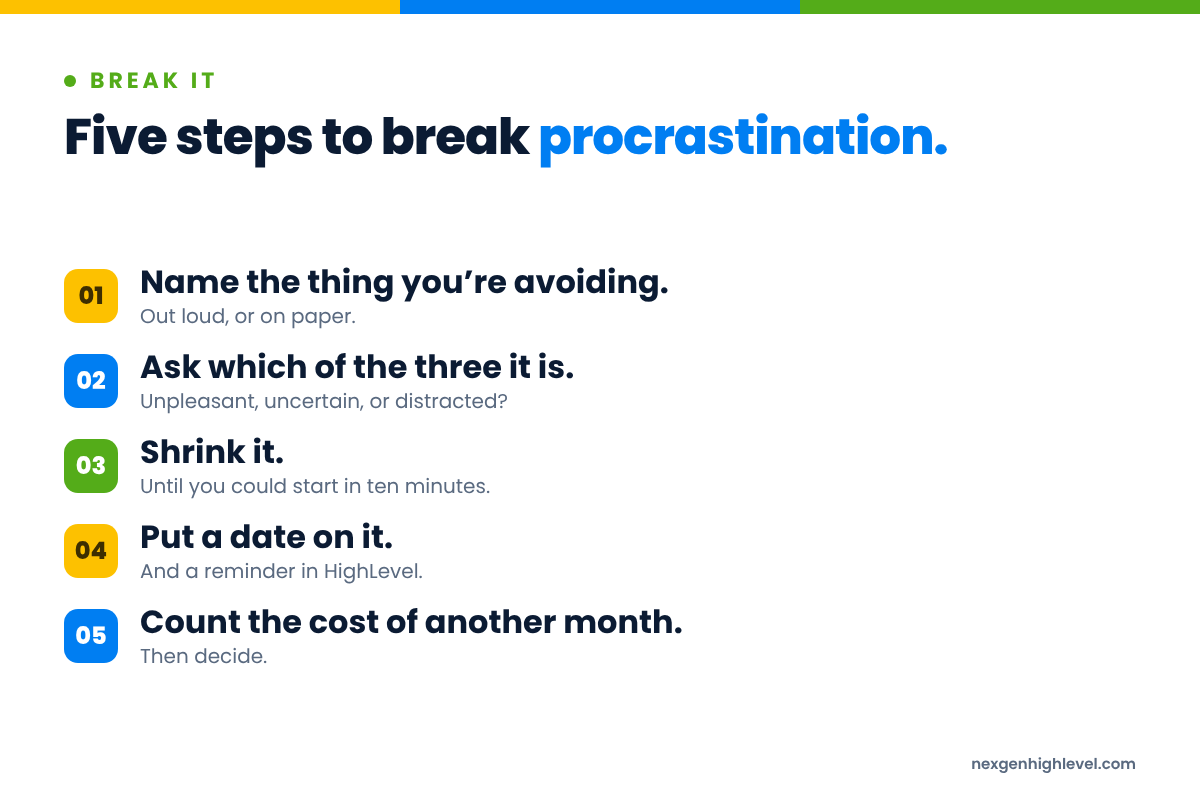
Step 1: Name the thing you're avoiding
Not the general fog. The specific thing. Write it down in one sentence.
"I'm avoiding calling the five people who said they might be interested."
"I'm avoiding putting a price on the website."
"I'm avoiding the follow-up on the proposal I sent three weeks ago."
You usually know exactly what it is. It's the thing that made you wince slightly as you read those examples.
Step 2: Ask which of the three it is
Is it unpleasant? Are you unsure you can do it well? Or is something shinier pulling you away?
One is usually loudest. If it's unpleasant, make it smaller. If you doubt yourself, borrow a structure someone has already tested. If something shinier is winning, close the tabs and do the hard thing before the inbox gets a vote.
Step 3: Shrink it until you can start in ten minutes
Keep breaking it down until the first step is almost too small to refuse.
"Call the five people" becomes "open my contacts and write down their names". Then "call the first one". That's it.
Step 4: Put a date on it, and a reminder
"I'll do it soon" isn't a plan. "I'll do it Tuesday at 9am" is.
Better still, put it somewhere outside your head that reminds you.
Step 5: Count what it would cost to wait another month
This is the uncomfortable one, and the most useful.
If you don't do this for another month, what does it cost you? Roughly. In leads, in revenue, in time, in confidence. Write a number down, even a rough one.
It's amazing how quickly "I'll get to it" turns into "I'll do it this afternoon" once you've given the waiting a price.
What procrastination is really protecting you from
There's one more thing I want to say, because it matters.
Procrastination is often protection. It protects you from finding out. If you never launch, you never find out whether people want it. If you never ask for the sale, you never hear "no". If you never put a price on it, nobody can tell you it's too expensive.
And the honest truth? Most of the things we're afraid of finding out are survivable. A "no" is information. A launch that doesn't work is information. A price that's too high is information.
Information is how businesses get better. Waiting is how they stay the same.
I've closed a business, backed terrible ideas and nearly talked myself out of good ones. Every one taught me something. The only things that taught me nothing were the things I never tried.
Most people can do far more than they give themselves credit for. They just have to start before they feel ready.
Nobody feels ready. That's not a sign you should wait. It's just what starting feels like.
Frequently asked questions
What is procrastination in business?
It's putting off the actions that move a business forward, like launching, selling, following up or deciding, usually in favour of tasks that feel safer or more pleasant. In business it often looks like work: research, tinkering, more planning. The test is simple. Is what you're doing moving you towards a paying customer? If not, there's a fair chance you're procrastinating, even if you're very busy doing it.
What does procrastination actually cost a small business?
More than most owners realise, because the cost is invisible. You pay in time you don't get back, revenue that never arrives, confidence that drains away, opportunities that go to someone else and leads that go cold while they wait to hear from you. None of it shows up as a line on your accounts. That's exactly why it's so easy to ignore, and so expensive to keep paying.
Why do I procrastinate even though I want my business to succeed?
Wanting it isn't the problem. Research by Piers Steel found that task aversiveness, low self-efficacy and impulsiveness were among the strongest predictors of procrastination. In plain English: the task is unpleasant, you're not sure you can do it well, and something easier is right there. That describes most important first steps in a new business. It's a design problem more than a discipline problem.
How do I stop procrastinating when starting a business?
Shrink the first step until you can start it in ten minutes. Name exactly what you're avoiding, borrow a structure instead of facing a blank page, remove the distractions, and put a date and a reminder on it. Then ask what another month of waiting would cost you. Templates and proven systems help a lot here, because the less you have to invent from nothing, the less there is to put off.
Can marketing automation help with procrastination?
It can help with the procrastination that costs you leads. In HighLevel, Workflows can reply to new enquiries straight away, send reminders, and flag conversations that have stalled, so the follow-up doesn't depend on you remembering tomorrow. What it can't do is fix a weak offer or make your decisions for you. Use it to remove the forgettable steps, not to avoid the important ones.
Is it ever right to wait?
Yes. Waiting is fine when it's a decision, not a habit. If you're waiting because you need specific information, or because you're walking before you run, that's sensible. I learned that the hard way. The trouble is waiting with no reason and no end date. If you can't say what you're waiting for, or when you'll stop, it's probably procrastination.
The cheapest day to start
Every business I've ever been involved in, the recruitment firms, the agency, the car leasing broker, NexGenHighLevel, started before I felt ready. And every one of them taught me more in its first month of doing than in any month of preparing.
I'm still a terrible procrastinator. I still catch myself tinkering when I should be shipping. The difference now is that I know what the waiting costs, and I've stopped pretending it's free.
So pick the thing you've been putting off. Make the first step small enough to start in ten minutes. Borrow whatever you can instead of building it from nothing. And then do it, today, before your brain finds something shinier.
Today is always the cheapest day to start. Tomorrow costs more.
Waiting feels free. It's the most expensive thing you own.