
Courage Gets You Started. Systems Keep You Going.
Everybody talks about the jump.
The day you hand in your notice. The day you sign the lease. The day you tell your family you're doing it, and watch their faces try very hard to look supportive.
Becoming an entrepreneur does take courage. I've made that jump more than once, and I won't pretend any of them felt comfortable.
But here's what nobody puts on the poster. The jump is one day. What comes after it is every other day.
And the people who stay in business aren't always the bravest ones. Very often they're the ones who stopped spending their courage on things that didn't need it.
Courage gets you started. Systems keep you going.
What becoming an entrepreneur actually takes
There's a picture in most people's heads of what an entrepreneur looks like.
Somebody fearless. Somebody who doesn't need sleep. Somebody who jumps off the cliff and builds the plane on the way down, as the saying goes.
I've never been that person. I'm a terrible procrastinator. I'm a perfectionist, which is delightful for everyone who has to work with me. I have ADHD, so I'm all over the place at times and hyper-focused at others.
And I've still started businesses. More than one.
So let me offer a different picture.
Becoming an entrepreneur takes two things, and they're not the same thing.
- The courage to start. To make a decision with incomplete information, put your name on something and accept that it might not work.
- The structure to stay. To turn that one brave decision into hundreds of ordinary days that get the work done, follow up with the customer, send the invoice and do it again tomorrow.
The first one gets all the attention. The second one decides how long you last.
Starting is more common than you think
You're not alone in wanting to do this. Not even close.
In the US, business applications for September 2026 came to 534,947, seasonally adjusted, according to the Census Bureau. That's one month.
Now, an application isn't a launched business. Plenty of those never trade a single day. But it tells you something. Hundreds of thousands of people, every month, are standing where you might be standing right now, thinking "Is this the time?"
So the urge to start isn't rare. What's rarer is staying.
Staying is the hard part
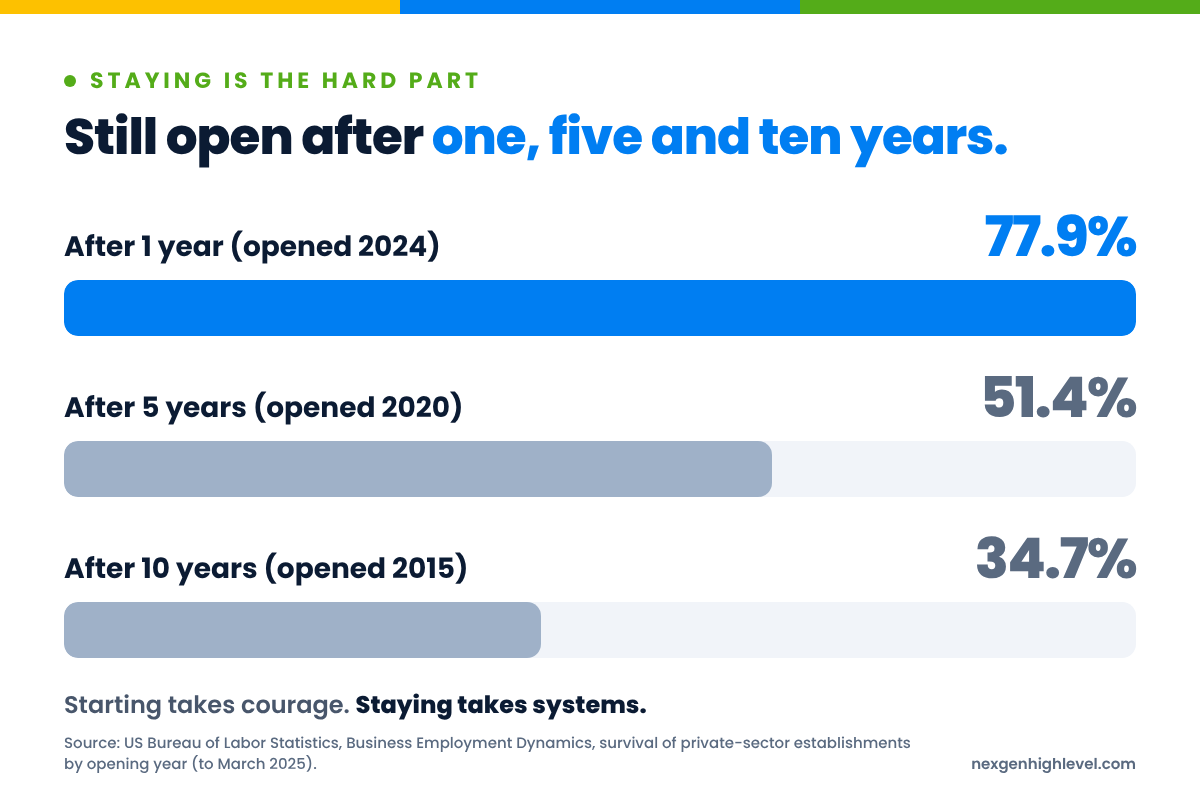
The Bureau of Labor Statistics tracks how long new business establishments last. Not firms, establishments, meaning individual locations. The BLS survival table is sobering reading.
| Opened in the year to March | Still operating in March 2025 | Share still open |
|---|---|---|
| 2024 | After 1 year | 77.9% |
| 2020 | After 5 years | 51.4% |
| 2015 | After 10 years | 34.7% |
Roughly one in five new establishments had closed within the first year. About half were gone within five. Around two in three within ten.
I'm not showing you that to frighten you. And I'm not going to pretend I know why each of those businesses closed. Some ran out of money. Some had an offer nobody wanted. Some owners simply decided they'd rather do something else, which is a perfectly good reason.
I'm showing you because it makes the point better than I can. Getting started is the first hurdle. It's not the one that takes most people out.
The leaps I took, and what each one taught me
I want to be honest about my own jumps, because I think the honest version is more useful than the polished one.
The first recruitment business
I fell into IT recruitment almost by accident, after being made redundant from an IT maintenance company in 1996.
And I loved it. It was face to face. Networking. Doing deals. There was no LinkedIn, no email, no CRM, no computers on desks. A telephone, a filing cabinet and a phone directory.
About two years in, I started my first recruitment business.
Was that brave? I suppose so. But at the time it didn't feel like courage. It felt like the obvious next step, the way a lot of big decisions do when you're in your twenties and haven't yet learned to be scared of things.
What it taught me was that running a business pulls you into everything. Running my own recruitment firm dragged me into marketing, because suddenly I needed people to know we existed. Nobody warns you about that. You start a business to do the thing you're good at, and within months you're also the marketing department, the finance department and the person who changes the toner.
The car leasing broker
Years later, in 2019, I started a car leasing broker business.
Different industry. Different customer. Same lesson, only louder.
It was all about online lead generation and digital marketing. The cars were the cars. Everybody had access to roughly the same deals. What separated one broker from another was how well you found people, how fast you got back to them and how well you followed up.
And the deeper I went into it, the more gaps I saw in marketing automation. Things that should have been simple were manual. Things that should have been connected weren't.
That leap didn't just teach me about cars. It taught me that a business without a system is a business that depends on you remembering everything. And I've already told you about my memory.
Covid, and then NexGenHighLevel
Then Covid arrived, and my recruitment business didn't survive it.
Furlough would have covered salaries. It didn't cover rent, property taxes, leases or software licences, and no supplier cut me a break. I had to make the team redundant to protect my family's security.
It was the hardest business decision of my life. Not because the company closed. Companies can be rebuilt. It was the people across the table, whose lives were changing because of my decision.
I'd grown that business aggressively, with heavy overheads, and I never foresaw the world just stopping. Nobody did. But that's where my rule comes from: walk before you run. And even when you're ready to run, keep walking a bit longer.
In 2020 I found HighLevel. It opened my eyes to what marketing automation could really do. And I noticed something. HighLevel's line was "Capture, Nurture, Close". I kept asking: where's the prospecting? Where's the outreach? Where's the market creation?
Nobody was filling that gap. So we started building. That became NexGenHighLevel.
Was it brave to start again after closing a business I'd spent years building? Yes. I think it probably was.
But here's the thing I want you to notice. The courage was the easy bit to find. What I'd learned, the hard way, was that courage on its own isn't a plan.
Courage is a resource, and you only get so much
This is the idea I'd like you to take away, even if you forget everything else.
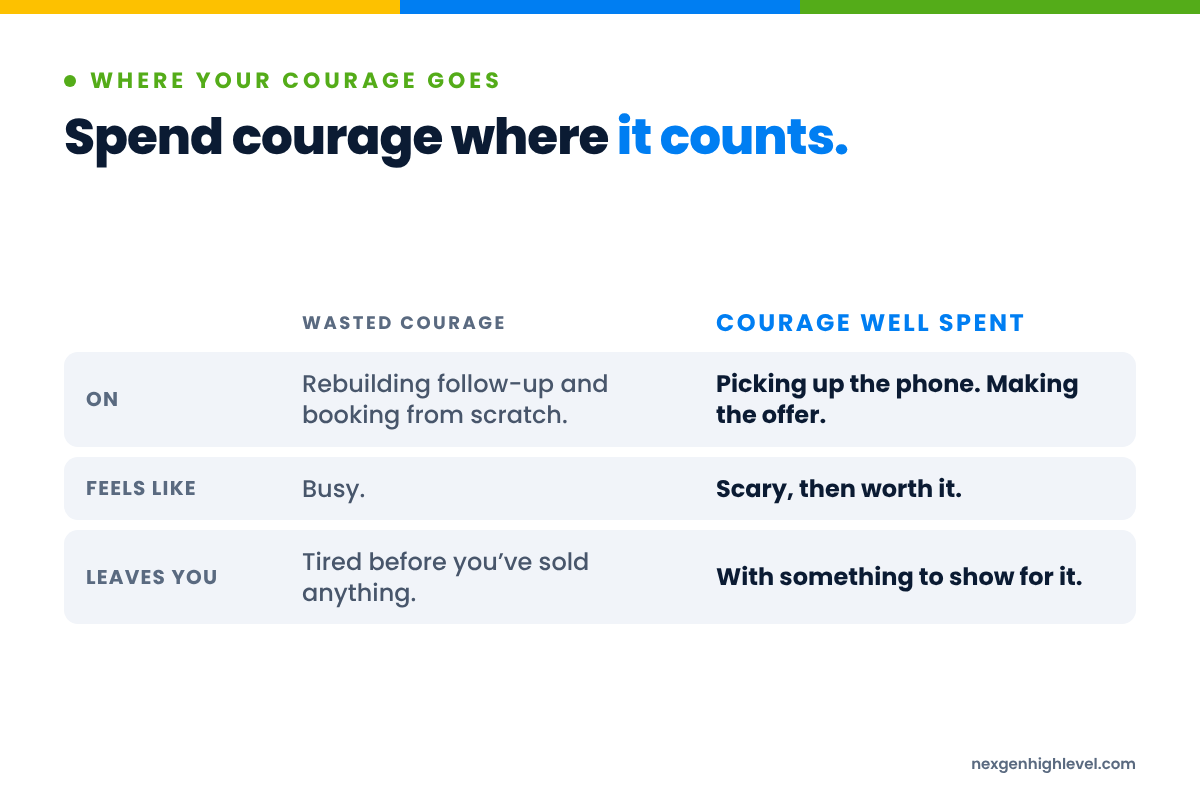
Courage isn't a personality trait you either have or don't. It's more like a fuel tank. You fill it up, and every hard decision draws from it.
Telling your partner you're leaving a steady job. Calling a prospect who might say no. Raising your prices. Letting a bad client go. Saying "I don't know" in front of someone you want to impress.
Every one of those costs you something.
Now picture spending that same fuel on things that don't need it.
Building your booking process from nothing at eleven o'clock at night. Writing your fifth version of a follow-up email because you can't decide on the subject line. Worrying whether you forgot to remind Tuesday's appointment. Reinventing, from scratch, something that thousands of businesses have already worked out.
None of that needs courage. But it drains you exactly the same way. It's the stress of not knowing whether something will work, repeated a hundred times over.
By the time a decision comes along that really does need nerve, the tank is empty.
Two owners, same street, same day
Picture two people opening a cleaning business on the same day, in the same town.
They're equally brave. Both left good jobs. Both put savings on the line. Both are good at cleaning.
The first one decides to work everything out personally. How enquiries come in. How quotes go out. How to remind customers. How to ask for reviews. What to send when someone goes quiet. They build it bit by bit, between jobs, mostly in their head and a notebook.
The second one sits down before launch and decides: I'll borrow what already works. A proven way of capturing enquiries. A follow-up sequence. Appointment reminders. A review request after every job. They change the wording to sound like them, and they get on with cleaning.
Six months in, who has more energy left for the scary stuff? Hiring their first person. Pitching the office contract. Putting the prices up.
It's not that the first owner was less brave. It's that they spent their bravery on plumbing.
Where new business owners waste their courage
If you've started a business, or you're about to, you'll recognise some of these. I've done most of them myself.
Reinventing the basics
Every business needs the same handful of things. A way for people to find you. A way for them to get in touch. A way to respond quickly. A way to book or buy. A way to follow up when they don't. A way to keep customers coming back and telling their friends.
These aren't secrets. They're plumbing. And most new owners rebuild the plumbing themselves, by hand, because it somehow feels more "theirs" that way.
It's not more yours. It's just slower.
Perfecting before launching
This one is mine. I'm a perfectionist, and I know exactly how it feels to polish something for weeks because launching it means finding out whether it's any good.
Planning matters. The research actually backs that up. But there's a point where planning stops being preparation and starts being a hiding place. I've written more about that in why planning can become a hiding place.
The short version: a plan you can test this month beats a perfect plan you'll test next year.
Waiting for the right moment
There isn't one. There's never a week where the diary is clear, the market is calm and you feel completely ready.
Waiting feels safe. It isn't. It's just expensive in a way you can't see on a bank statement. I've written about what procrastination really costs a business, and it's more than most people think.
Six weeks to find out beats six months of wondering.
Doing it all from memory
When you're small, you can hold it all in your head. Who called. Who needs a quote. Who said "call me next month".
Until you can't.
Somebody falls through the cracks. Then another. And because there's no system, you don't even notice it happening. You just notice that things feel busy and the bank balance doesn't seem to agree.
The three personalities that get stuck
I've found that people get stuck because of personality more than anything else. I see three types, and I've been all three.
- The Tinkerer. Buried in the tech. Building and rebuilding. Forgets why they started using it in the first place. Slow to actually deploy anything.
- The Rusher. Gets everything to market as fast as possible. Skips the setup. Wonders later why it all feels held together with sticky tape.
- The Magic-Bullet Believer. Thinks every new tool is the answer. Buys it, never learns to use it properly, moves on to the next one.
My advice is the same for all three. Know your goal, plan properly, set up properly, understand properly. Then go for it.
Which type are you? Be honest. Nobody's watching.
Systems are how brave people stay in business
So what's the alternative?
It's not "be less brave". It's to put structure under your bravery, so it gets spent where it counts.
A system, in the plainest sense, is just a decision you only have to make once.
How do new enquiries get answered? Decided. What happens if someone doesn't show up? Decided. When do we ask for a review? Decided. What does a customer hear from us after the job is done? Decided.
Once those are decided and running, you don't need to find the nerve to face them every day. They just happen. And your attention is free for the things only you can do: talking to customers, improving the offer, making the big calls.
The franchise lesson
The franchise world understood this a long time ago.
Ray Kroc visited the McDonald brothers in 1954, and that visit led to him becoming their franchise agent. He opened his first McDonald's in Des Plaines, Illinois, in April 1955.
That was a leap. But look at what came next. Fred Turner, who began as a grill man at Des Plaines, went on to write the chain's first Operations and Training Manual in 1958, codifying the standards the company still uses.
Kroc took the leap. Turner wrote down how to do the work. You need both.
I'm not saying franchising is right for everybody. It's a proven model with real strengths: a tested system, a recognised brand, training and support. It also comes with real trade-offs: upfront fees, ongoing royalties, rules about how you operate, and less freedom to do things your own way. Some people love that deal. Some people would hate it.
But the principle underneath it applies to every business, franchise or not. Don't make every new owner work everything out from scratch. Hand them something that works, and let them spend their energy running it.
Working on the business, not just in it
Michael Gerber's The E-Myth Revisited makes a distinction I think every new owner should hear early. The publisher's description puts it as the difference "between working on your business and working in your business".
When you're starting a business, you're almost always working in it. Doing the jobs. Answering the phone. Chasing the invoice.
Systems are how you get to work on it. They take the repetitive stuff off your plate so there's time, and energy, to think about where the business is going.
It's not glamorous. It's how you stay open.
Brave and smart are not opposites
There's a strange idea floating around that using something ready-made is somehow a lesser kind of entrepreneurship. That if you didn't build it all yourself, from scratch, it doesn't really count.
I don't buy it.
A chef doesn't invent the knife. A builder doesn't forge their own nails. A pilot doesn't write the pre-flight checklist from memory every morning. They use what already works, so their skill goes into the bit that matters.
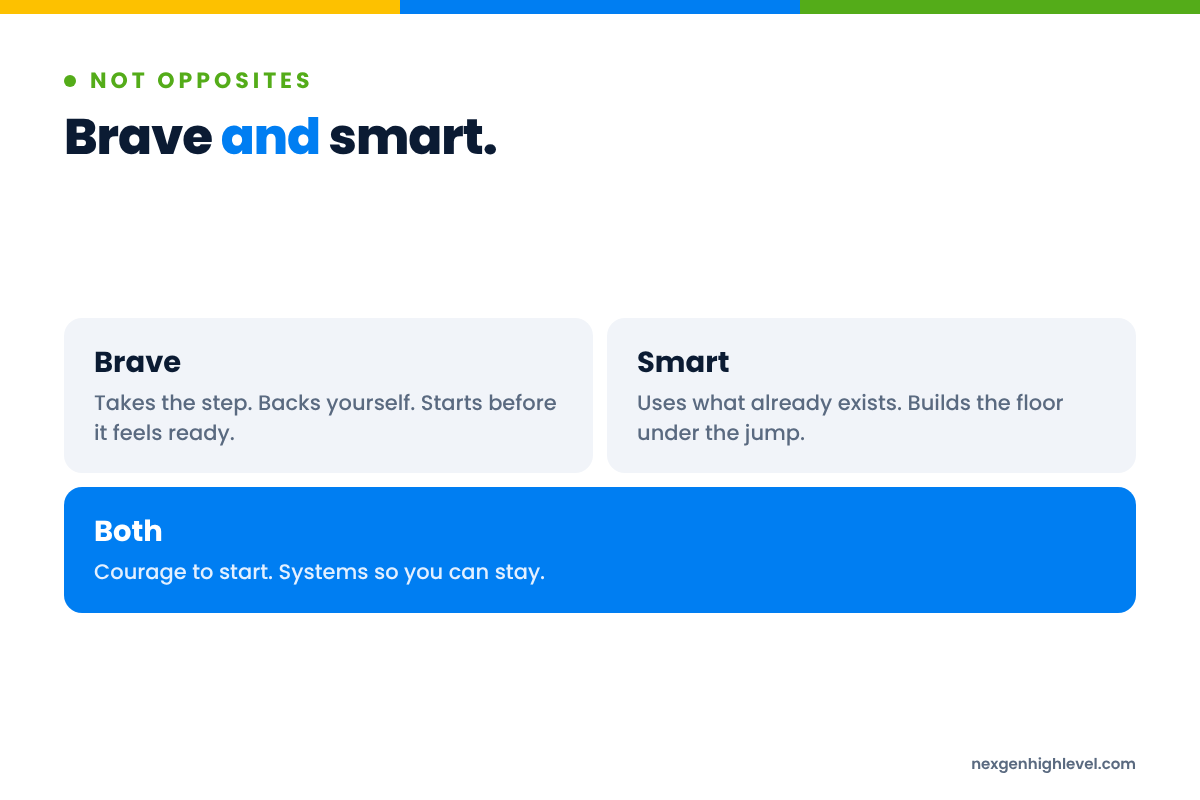
Being brave is deciding to start. Being smart is deciding not to waste that bravery reinventing what already exists.
You can be both. In fact, I'd argue you need to be both.
What "borrowing a system" looks like in practice
For most small businesses today, a lot of the system lives in their marketing and customer software. For us, that's HighLevel.
HighLevel puts the plumbing in one place. Contacts and custom fields so you actually know who your customers are. Forms and funnels so people can get in touch. Conversations, a unified inbox, so a message on one channel doesn't get lost while you're looking at another. Calendars with confirmations and reminders. Workflows that follow up when you're busy. Pipelines so you can see every opportunity and where it's stuck. Review requests after a job. Reporting so you can see what's actually paying.
The point isn't the features. The point is that each of those is a decision you've made once, so you don't have to make it again on a Tuesday afternoon when you're tired.
And you don't even have to build all of it yourself. HighLevel has a way of packaging a whole account setup, called a Snapshot, so a working system can be loaded into a new account. We build fully built-out HighLevel Snapshots for specific niches, for business owners in those niches and for agencies serving them. Clients have used them to skip months, if not years, of trial and error building a system.
But let me be very clear about something.
A system is not magic
No system replaces a good offer. No workflow understands your customer for you. No template does the work.
Technology is leverage, not strategy. And leverage multiplies whatever is underneath it. Put a great system behind a weak offer and you've just found a very efficient way of telling more people about something they don't want.
That's why I always come back to the same three words.
- Human. Who is the customer, really? What do they want? What frightens them? What stops them buying?
- Strategy. What's your offer, your message, the journey you'll take them on?
- Leverage. Only then: the automation, the workflows, the system.
Human. Strategy. Leverage. In that order.
If you multiply zero by a thousand, you've still got zero. Courage and systems together still need something worth multiplying.
Back yourself, then build the floor under you
I want to say something to the person reading this who's still on the fence.
You're probably better than you think.
Nobody has it all figured out. Not the person with half a million followers. Not the person posting their sales screenshots. Not me. Everybody is working with incomplete information. Some people are just more comfortable deciding anyway.
That's all backing yourself really means. Not certainty. A willingness to decide, learn, and adjust.
But backing yourself isn't the same as being reckless. I learned that the hard way. You can back yourself and still build a floor under your feet.
Walk before you run
When I closed my recruitment business, one of the hard lessons was about pace. I'd grown fast. I'd taken on overheads that only made sense if everything kept going right.
So now I walk before I run. And even when I'm ready to run, I keep walking a little longer. I only run when I can see the green field stretching out in front of me.
For someone becoming an entrepreneur, that might look like this:
- Start lean. Keep fixed costs low until you know what's working.
- Get the system in place early, before you're too busy to set it up.
- Talk to customers before you polish anything.
- Grow headcount after the system is carrying the load, not to make up for the lack of one.
I've written more about growing a business without growing the chaos, because scaling on overheads instead of systems is a mistake I'd rather you didn't repeat.
Six weeks beats six months
There's a version of courage that's really just impatience, and a version of caution that's really just fear. The trick is to find a pace in between.
Here's a rule I use. If I'm unsure whether something will work, I'd rather find out in six weeks than wonder about it for six months.
Six weeks is long enough to learn something real. It's short enough that if it's wrong, you haven't bet the house.
And the research on planning actually points in a similar direction. Greene and Hopp, at the University of Edinburgh Business School, found that entrepreneurs who write formal plans are 16% more likely to achieve viability. But timing mattered. Planning done alongside talking to customers helped most, and planning that went on too long didn't help, because the information went stale.
So plan. Just don't plan instead of starting.
Questions to ask yourself before you jump (and after)
I'm not going to give you a checklist that promises success. Nobody honestly can. But here are the questions I'd want to be able to answer, whether you're about to start or you're already a year in and feeling stretched.
About the courage
- What, specifically, am I afraid of? Write it down. Fear is much smaller on paper.
- What's the worst realistic outcome, and could I recover from it?
- Who depends on this decision, and have I talked to them honestly?
- Am I waiting for more information, or am I waiting to feel ready? (They're not the same thing.)
About the system
- If a new enquiry came in right now, what would happen? Would anything happen if I didn't see it?
- If a customer didn't show up tomorrow, what would they hear from us?
- What am I doing by hand, every week, that a thousand other businesses have already worked out?
- Which decisions do I keep remaking that I could make once?
About the business
- Who is my customer, really, and why should they care?
- Is the offer good enough to be worth multiplying?
- Does it make any money? Not clicks. Not bookings. Revenue and profit.
If you can answer most of those, you're in better shape than you think. If you can't, that's not a reason to stop. It's a list of what to work on next.
A quick way to see where your courage is going
Try this for one week. Every time something stresses you, jot it down in one of two columns.
| Needs my courage | Needs a system |
|---|---|
| Pitching a bigger client | Remembering to follow up a quote |
| Raising prices | Reminding people about appointments |
| Hiring my first person | Asking happy customers for a review |
| Letting a bad-fit client go | Answering the same five questions |
At the end of the week, look at the right-hand column. Every item there is courage you're spending that you don't need to.
Fix that column, and the left-hand one gets easier. Not easy. Easier.
Becoming an entrepreneur with HighLevel behind you
I'll be honest about why I care so much about this.
When I started out in recruitment, the "system" was me, a phone and a filing cabinet. It worked because I was young, I loved it and I had energy to burn. It also meant that when I wasn't there, nothing happened.
When I ran my marketing agency, I saw the other side. Business owners, mostly in private healthcare, who were brilliant at what they did and brave enough to open their own practices. Many of them were relying on one channel, and results were getting worse. Our agency usually rebuilt from the ground up, because the problem was rarely the ads. It was everything around them. The whole system, from someone discovering the business to becoming a paying customer.
And now, with NexGenHighLevel, I get to build the tools I wish I'd had.
Everything we build sits natively inside HighLevel, using what's already there: Workflows, Contacts, Tags, Conversations. No bolt-ons, no extra connectors to babysit. If you're starting out and haven't set up an account yet, you can get a HighLevel account through us.
But even if you never use anything we make, the principle stands. Find out what already works. Use it. Make it yours. Then spend your courage on the things that genuinely need it.
Frequently asked questions
What does it really take to become an entrepreneur?
Two things. The courage to start, which means deciding with incomplete information and accepting it might not work. And the structure to stay, which means turning one brave decision into hundreds of ordinary days of follow-up, delivery and invoicing. Most people focus on the first. In my experience the second decides how long you last. You don't need to be fearless. You need to be willing to decide, and smart about where you spend your energy.
Is it smart to use templates or ready-made systems when starting a business?
I think so. Using what already works isn't cheating. It's how chefs, pilots, builders and franchises have always operated. A ready-made system takes care of the basics everyone needs, so your time goes into the bit that makes you different. Just remember a template isn't a business. You still need a good offer, a real understanding of your customer and the willingness to do the work.
How do I know when I'm ready to start a business?
Honestly? You probably won't feel ready. Nobody does. A better question is whether you're waiting for information or waiting for a feeling. If it's information, go and get it, ideally by talking to real customers. If it's a feeling, that may never come. I'd rather find out in six weeks than wonder for six months. Start small, keep costs low and learn fast.
What systems does a new business need first?
The basics nearly every business shares. A way for people to get in touch. A fast response to every enquiry. Booking with confirmations and reminders. Follow-up for people who go quiet. A review request after each job. And a simple way to see what's making money. In HighLevel, those live together: forms, Conversations, calendars, Workflows, pipelines, review requests and reporting, all in one account.
Can a business owner run HighLevel themselves, or do they need an agency?
Plenty of business owners run HighLevel themselves, and many like having that control. Others prefer an agency to set it up and run it for them, and that's a perfectly good choice too. What matters is that somebody understands the customer and the strategy before the technology goes in. Human, Strategy, Leverage. If that thinking is in place, either route can work well.
Spend your courage where it counts
Becoming an entrepreneur is brave. I'll never take that away from anyone who's done it, or anyone who's thinking about it right now.
But bravery is a resource. It runs out. And most new owners burn through it on things that never needed it: rebuilding the basics, perfecting instead of launching, holding the whole business in their heads.
You don't have to do that.
Back yourself to make the jump. Then be smart enough to borrow what already works, so the ordinary days look after themselves and your nerve is still there when the big decisions arrive.
Brave and smart are not opposites. The people who last are usually both.
Be brave about the things that matter. Be boring about everything else.