
What the Franchise Model Gets Right About Starting Up
Picture two people opening a cleaning business on the same Monday morning.
One bought a franchise. The other is going it alone. Same town, same van, same ambition.
By Friday, the first one has a booking process, a price list, a script for the phone, a checklist for every job and a way of asking for reviews. Somebody else worked all of that out years ago. The second one is still deciding what colour the logo should be.
That's the first of the franchise model lessons I think every new business owner should learn, whether they ever go near a franchise or not.
The franchisee didn't buy a brand. They bought a system that already works.
And here's the question I keep coming back to. If a working system is that valuable, why do so many independent owners insist on building their own from a blank page, one painful mistake at a time?
A franchise sells a system, not a logo
Most people think of franchising as a brand you rent. The sign over the door. The uniform. The name people already recognise.
That's real. But I don't think it's the main thing being sold.
What a franchisee is really paying for is the answer to a thousand small questions they'd otherwise have to work out on their own. How do we take an order? What happens when a customer complains? What does a good day look like? What do we do first thing in the morning? Who calls back the lead that came in at 4.55pm on a Friday?
Every one of those questions has an answer already. Tested. Written down. Taught.
It's not a logo. It's a decade of somebody else's trial and error, packaged up so you don't have to repeat it.
Why that matters more than people think
When you're starting a business from scratch, nobody tells you how much of your time goes on the boring stuff.
Not the work you're good at. The plumbing around it. Booking, chasing, reminding, invoicing, following up, asking for reviews.
I've built businesses with heavy systems and businesses with almost none. I spent nearly 23 years in recruitment, and when I started there was no email, no CRM and no computer on the desk. A telephone, a filing cabinet and a phone directory. The system was whatever I could hold in my head and scribble on a notepad.
It worked, mostly. But every new person had to learn it the way I did. By getting it wrong.
That's the hidden cost of starting from scratch. It isn't just the time it takes you. It's the time it takes everyone who comes after you.
Franchising is bigger than most people realise
This isn't a niche corner of the economy, either.
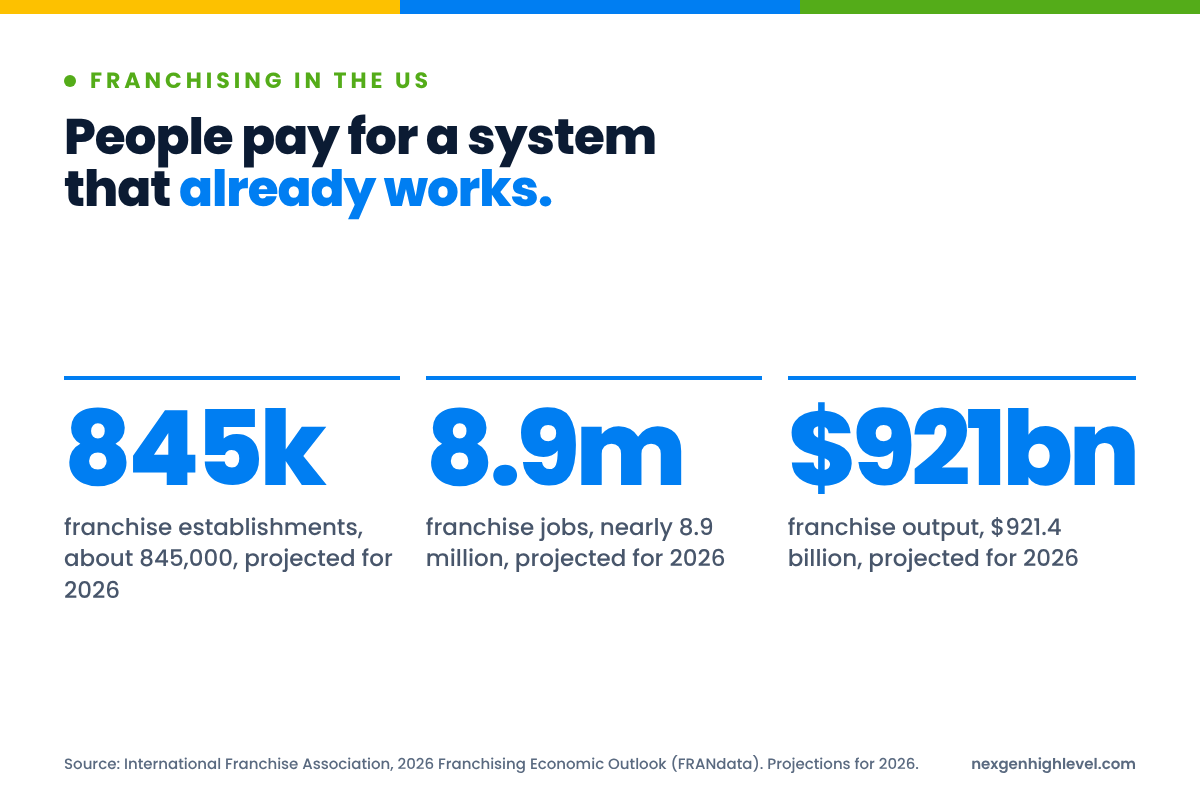
The International Franchise Association's 2026 outlook, produced by FRANdata, projects franchise establishments will rise from 832,521 in 2025 to about 845,000 in 2026, with franchise employment expected to increase by more than 150,000 jobs to nearly 8.9 million.
Those are projections, not promises. But they tell you something. A lot of people, every year, decide they would rather start with a working system than invent one.
That's not a lack of courage. That's a decision about where to spend it.
Franchise model lessons from McDonald's history
You can't talk about systems and franchising without talking about McDonald's. Not because it's the only story, but because the history shows the thinking so clearly.
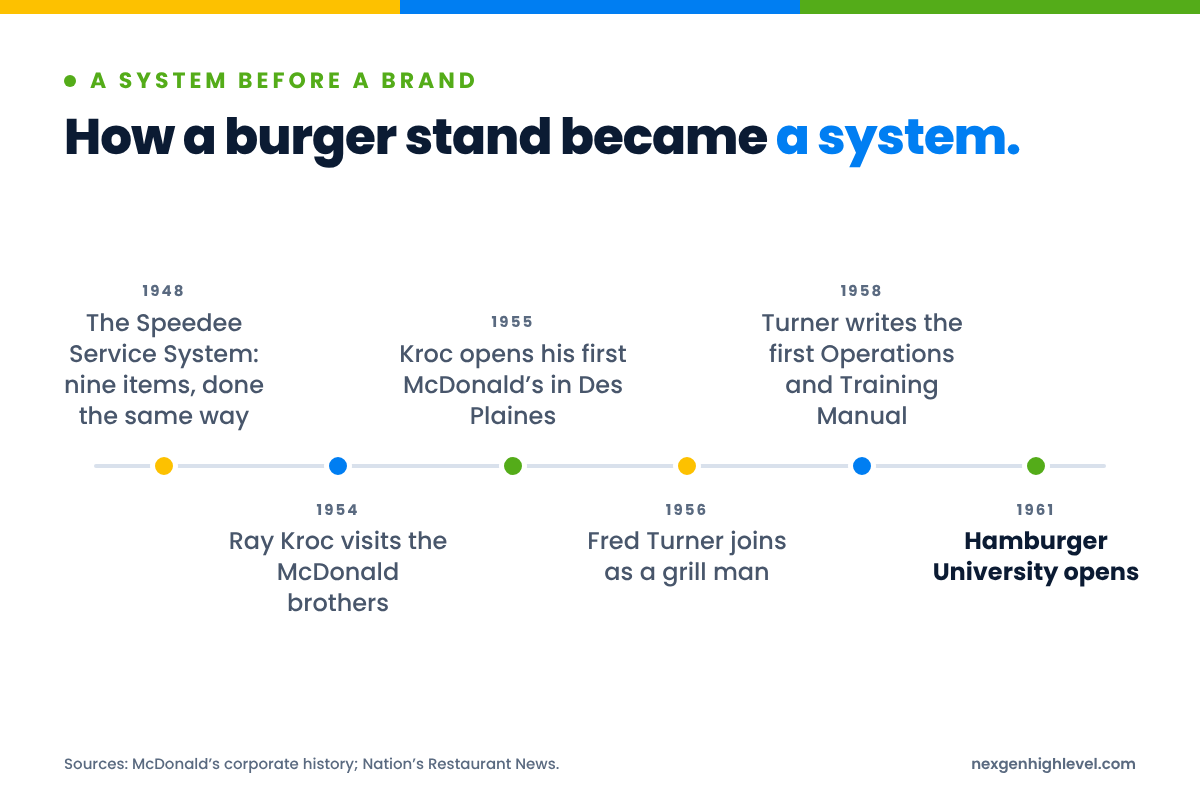
Here's what the company's own history says.
In 1948, the McDonald brothers streamlined their restaurant around the "Speedee Service System", with a nine-item menu and a 15-cent hamburger.
Nine items. That's the bit I love.
They didn't add things. They took things away. They worked out what customers actually wanted, cut everything else, and built a process so tight it could be repeated quickly, every single time.
The visit that changed the model
In 1954, Ray Kroc visited the brothers, a visit which, in the company's words, "led to him becoming their franchise agent". He opened his first McDonald's in Des Plaines, Illinois, on April 15, 1955. First-day sales came to $366.12.
Not exactly an overnight empire.
I like that number because it punctures the myth. The stories we tell about big businesses usually skip the first day and the first slightly embarrassing set of takings.
Simple isn't amateur
The lesson I take from the Speedee Service System isn't "be like McDonald's". Most of us aren't selling burgers, which is just as well, because I'd be a terrible fry cook.
The lesson is this. Simple isn't amateur. Simple is often what you arrive at once you really understand something.
A lot of new owners do the opposite. They add services, packages, channels and tools before the business has proven anything at all.
Ask yourself honestly. What's your nine-item menu? What would you cut if you had to make your business repeatable by someone who isn't you?
The operations manual is the quiet hero
Here's what doesn't get nearly enough attention.
Fred Turner joined in 1956 as one of McDonald's first employees. He began as a grill man at Des Plaines and coined the mantra known as QSC: Quality, Service and Cleanliness.
According to his obituary in Nation's Restaurant News, Turner authored the chain's first Operations and Training Manual in 1958, and codified the operational standards the company still uses in its restaurants.
Think about that. A grill man wrote down how the work should be done. And it outlived him.
Then, in 1961, the company opened Hamburger University in the basement of the Elk Grove Village restaurant, where graduates receive Bachelor of Hamburgerology degrees. Which is, I'll admit, a better title than anything on my own CV.
Why the manual matters more than the menu
A menu tells you what you sell. A manual tells you how you deliver it, every time, regardless of who's on shift.
That's the difference between a business and a person with a job they've made for themselves.
If everything lives in your head, you don't have a system. You have a memory. And memories are terrible at scaling and terrible on holiday.
Most small businesses have no manual at all
I don't say that as a criticism. When you're starting a business, writing a manual feels like the last thing you've time for. You're too busy doing the work.
But here's the irony. The reason you're too busy is often that you don't have one.
Every time you answer the same question twice, chase the same kind of lead by hand, or rebuild the same follow-up from memory, you're paying a tax for not having written it down.
A manual isn't bureaucracy. It's the thing that lets you stop being the bottleneck in your own business.
Working on the business, not in it
Michael Gerber's The E-Myth Revisited is one of those books that gets recommended so often people stop actually reading it. Which is a shame.
The publisher's description sums up its central idea as "the vital, often overlooked distinction between working on your business and working in your business". It also makes the point that "common assumptions, expectations, and even technical expertise can get in the way of running a successful business".
That second line stings a bit, doesn't it?
Technical expertise getting in the way. The great electrician, the brilliant designer, the talented coach who starts a business because they're good at the work, and then discovers the work is only one piece of it.
Being good at the work isn't the same as running a business
I've seen this from both sides.
In my agency years, we built whole marketing systems for clients, mostly private medical practices in the US. Ads, Google, local SEO, social, content, nurture, reputation, booking follow-up. All of it working together, judged on the client's revenue and profit, not on clicks.
The practices were run by brilliant clinicians. People who were exceptional at the work they'd trained for. But they hadn't gone into healthcare to become marketers, or to design follow-up sequences, or to work out why bookings weren't turning into patients.
They were working in their business. Somebody needed to be working on it.
That's what a franchise system does for a franchisee. It hands them the "on" part, already done, so they can get on with the "in" part.
The franchise system does the "on" work up front
When a franchisee opens their doors, a lot of the strategic thinking has already been done. How to price. How to market locally. How to train staff. What the customer journey looks like from first contact to repeat purchase.
They still have plenty to do. Nobody is pretending a franchise runs itself. But they're not starting the "on" work from zero while also trying to do the "in" work.
That's the real head start. Not the logo. The thinking.
The trade-offs nobody should gloss over
I want to be fair here, because franchising is a proven model with real strengths, and people who choose it aren't taking a shortcut or doing anything wrong. For plenty of people, it's exactly the right decision.
But it comes with trade-offs, and anyone considering one should go in with their eyes open.
What you get, and what you give
| What a franchise usually gives you | What it usually asks in return |
|---|---|
| A tested system and operating procedures | An upfront fee to join |
| A recognised brand | Ongoing royalties on what you earn |
| Training and ongoing support | Rules on how you operate, what you sell and how you market |
| A network of other owners | Less freedom to change things that aren't working for you |
| Suppliers and processes already set up | Approval needed for many decisions you'd otherwise make alone |
None of that is a scandal. It's the deal.
That control is the point, by the way. The reason a franchise system works is that everyone runs it the same way. If every franchisee could change anything they liked, it would stop being a system pretty quickly.
Freedom is the price of the shortcut
So the trade-off is simple to describe and hard to weigh.
You trade some freedom for a head start.
For some people, that's a brilliant trade. They want structure. They want support. They'd rather follow a proven playbook than write one. Fair play to them.
For others, especially people who are stubborn about doing things their own way (I'm told I fall into that category, though I'd like to formally dispute it), the rules feel like a cage.
Neither is wrong. But you should know which one you are before you sign anything.
The franchise survival myth, handled honestly
There's a statistic that gets passed around about franchises. You've probably heard a version of it. Something like "franchises succeed 95% of the time".
I'm not going to repeat it as fact, because it isn't one.
Entrepreneur magazine has written about where it came from and calls it "completely unproven". According to that piece, it traces back to an unaudited, self-selected survey of franchisors from the 1980s, where a low closure figure got flipped into a "success rate". The IFA and the SBA have asked people to stop using it.
What the research actually says
The honest answer is that the research on franchise versus independent survival is mixed and dated.
One of the best-known studies, by Timothy Bates, followed firms started between 1984 and 1987 and found the independent start-ups in his sample were more profitable, with better survival prospects than the franchises. Later researchers, Castrogiovanni and Justis, argued that study has flaws that allow other readings.
So where does that leave you?
Somewhere honest. A franchise isn't a safe harbour, and an independent business isn't doomed. Neither label decides your fate.
Survival is hard for everyone
What we do know is that starting any business is hard. The US Bureau of Labor Statistics tracks new business establishments, and of those that opened in the year to March 2020, 51.4% were still operating five years later.
Roughly half. Franchise or not.
So I'd put the question differently. Don't ask "is a franchise safer?" Ask "what is it about a good franchise system that gives its owners a better chance, and can I have that without buying a franchise?"
That's a much more useful question. Because the answer is mostly about the system, and systems can be borrowed.
Borrowing franchise model lessons with a HighLevel Snapshot
So let's say you like the idea of a tested system but you don't want the franchise strings. You want to keep your own name, your own prices, your own way of doing things. You just don't want to build every process from a blank page.
What do you actually need?
If I strip the franchise idea down to the parts that matter for most service businesses, I get something like this:
- A way to capture enquiries from your website, ads and social, all into one place.
- A clear journey from new enquiry to booked appointment to paying customer.
- Fast, consistent follow-up, so nobody falls through the cracks.
- Reminders and confirmations, so booked appointments actually happen.
- A way to ask happy customers for reviews.
- A pipeline that shows you where every opportunity stands.
- Reporting, so you know what's working and what's just noise.
That's your operations manual, really. Not a binder on a shelf, but the actual machinery your business runs on.
What a Snapshot actually is
This is where HighLevel comes in.
HighLevel has a feature called Snapshots. It's the platform's way of packaging a whole account setup so it can be loaded into another account. Funnels, forms, workflows, pipelines, calendars, emails, texts, all of it, in one go.
At NexGenHighLevel, we build HighLevel Snapshots as complete, fully built-out business systems for a specific niche. A business system in a box. Funnels and forms to capture leads. Workflows to follow up. Pipelines to track opportunities. Calendars with confirmations and reminders. Emails and texts already written for that kind of business. AI features where they genuinely help. All connected around the whole client journey.
You install it into your HighLevel account and you start from a working system, not an empty screen. Then you make it yours.
It's not a starter pack. It's the thinking, already done.
I've written more about what a HighLevel Snapshot really is, and what it isn't, if you want to go deeper on that.
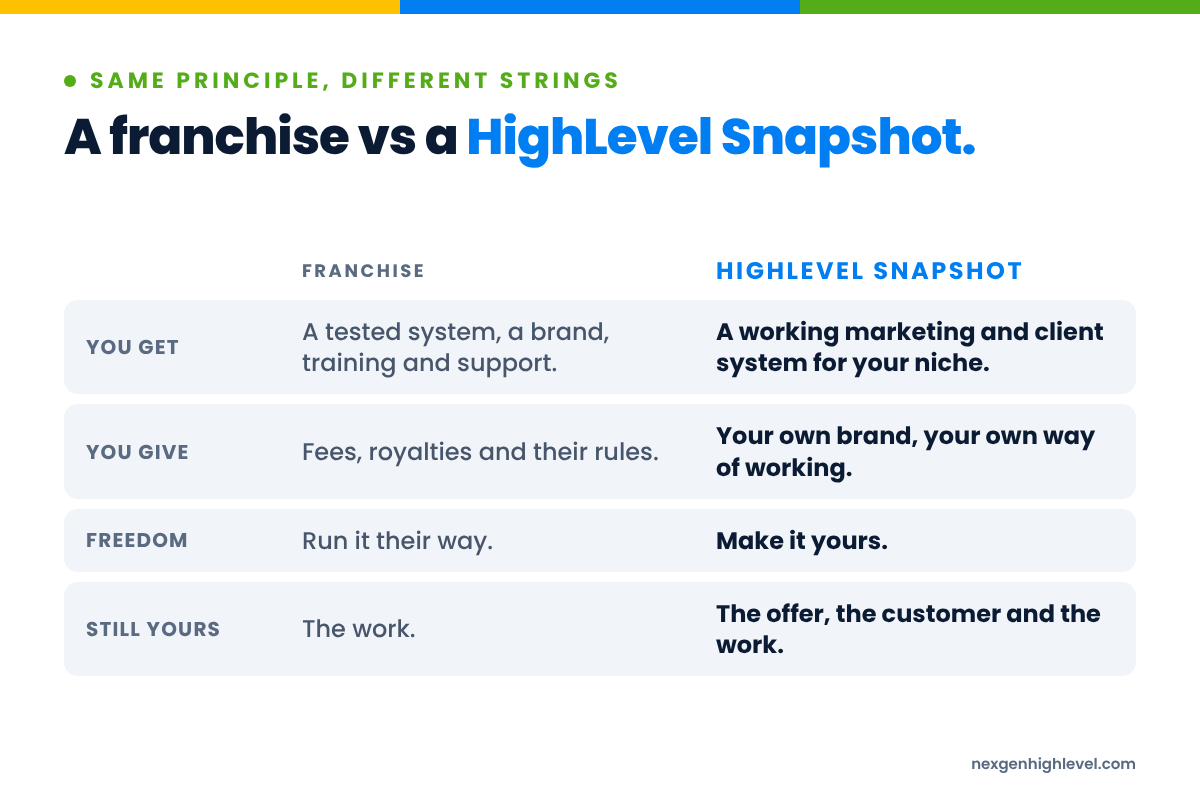
The franchise comparison, side by side
Here's how I'd frame the two approaches, honestly.
| Franchise | Independent with a HighLevel Snapshot | |
|---|---|---|
| Starting point | A tested operating system for the whole business | A built-out marketing and client system for your niche |
| Brand | Theirs | Yours |
| Rules on how you operate | Set by the franchisor | Set by you |
| Pricing and offer | Usually set or guided by the franchisor | Entirely your decision |
| Training and support network | Usually included | Up to you to find and choose |
| Ongoing share of revenue | Royalties | None to a franchisor |
| Freedom to change the system | Limited | Complete |
I want to be careful here. A Snapshot is not a franchise. It doesn't give you a recognised brand, a territory, a supply chain or a network of owners. A franchise covers far more of the business than marketing and client management.
But the core lesson, start from something that works rather than nothing, applies to both.
For the niche business owner
If you run a business in one of the niches we've built for, a Snapshot gives you the client journey already mapped and running in HighLevel.
Take a lawn care business. The Landscaping and Lawn Care Snapshot is built around how that kind of business actually wins and keeps customers. Enquiries come in, get followed up, get booked, get reminded, and get asked for reviews, without the owner rebuilding each step by hand.
We have live Snapshots for Credit Repair, HVAC, and Landscaping and Lawn Care, with more niches being built.
The owner doesn't need to become an automation expert to get the benefit. They need to understand their customer, run a good business, and make the system their own.
For the agency serving that niche
Here's what people sometimes miss. Snapshots aren't only for the business owner.
If you're an agency serving HVAC companies, for example, the same built-out system gives you something to deploy for each client, rather than rebuilding the same workflows every time you sign someone new. That's the franchise lesson again, applied to delivery: a tested system, repeated well.
And for agencies themselves, we've built a Snapshot for social media marketing agencies, so the agency's own client journey, from first enquiry to onboarding, doesn't have to be pieced together from scratch either.
Same principle. Different customer.
What a Snapshot isn't
Let me be straight about this, because I'd rather you hear it from me.
A Snapshot is not magic. It won't fix a weak offer. It won't make people want something they don't want. It won't do the work for you.
My core framework is Human, Strategy, Leverage. In that order.
- Human. Who is your customer? What do they want, what worries them, what stops them buying?
- Strategy. What's your offer, your message, your journey from stranger to customer?
- Leverage. Only then does the technology come in. A Snapshot is leverage.
Leverage multiplies whatever is underneath it. Put a working system behind a good offer and a business that understands its customers, and it can do a lot of heavy lifting. Put it behind something nobody wants and you've just found a very efficient way of telling more people about it.
If you multiply zero by a thousand, you've still got zero.
What a Snapshot can do is take away the months of building. Clients have used Snapshots to skip months, if not years, of trial and error building a system. That's real, and it matters. But the offer, the customer understanding and the work are still yours.
That's not a weakness of Snapshots. It's the same with franchises. Plenty of franchisees with a fantastic system still have to show up, serve customers well and do the hard yards.
Questions to ask before you build anything
Whether you're weighing up a franchise or going independent, the useful questions are mostly the same. Here are the ones I'd ask myself before spending a cent.
About you
- Do I want structure handed to me, or do I want to design it myself?
- How do I react when someone tells me I have to do it their way? (Be honest. Nobody's watching.)
- Am I a builder by nature, or do I just want to get trading?
- Which of the stuck personalities am I closest to: the Tinkerer, the Rusher, or the Magic-Bullet Believer?
That last one matters more than people think.
The Tinkerer gets buried in the tech and forgets why they're using it. Give a Tinkerer a blank HighLevel account and they'll happily spend six months perfecting a workflow nobody has used yet. A built-out system can rescue a Tinkerer from themselves.
The Rusher rushes everything to market. A system gives a Rusher structure they'd never have built on their own.
The Magic-Bullet Believer thinks every tool is the answer and never learns to use one properly. Some people install an app and uninstall it the next day. Go figure. For them, the lesson is that no system works if you don't learn how it works.
I'll be honest, I see bits of all three in myself. I'm a terrible procrastinator and a perfectionist, which is a delightful combination for anyone who has to work with me. I have ADHD, so I'm either all over the place or completely locked in. Left to my own devices, I could polish a process forever.
Starting from a working system is how people like me actually get going.
About the business
- What's my nine-item menu? What am I really selling, to whom?
- What does a customer's journey look like, from first hearing of me to paying me to recommending me?
- Where would a lead get lost today?
- What would happen if I got sick for two weeks?
- What's the first thing I'd write down if I had to hand this business to someone else tomorrow?
About the system
- Do I need a full franchise system, or mainly a working marketing and client system?
- Is there something already built for my niche that I could start from and adapt?
- Have I got a HighLevel account to run it on?
- How quickly could I be live with real customers, rather than still planning?
That last question is the one I care about most.
Six weeks to find out beats six months
Here's what I've learned, the hard way.
Six weeks to find out beats six months of thinking about it.
When you're growing a business, a working system you can test with real customers this month will teach you more than a perfect one you're still designing in the spring. You'll change things. Of course you will. But you'll be changing something that exists, based on what real people actually did.
That's what a franchisee gets on day one. Something real to run.
It's also why I think using what already exists isn't a lack of ambition. I've written about why using a template isn't cheating, and about why you don't have to build your business from scratch. The bravest thing is starting. The smartest thing is not making it harder than it needs to be.
Walk before you run
One more thing, and it comes from the worst business moment of my life.
When Covid hit, my recruitment business didn't survive. Furlough covered salaries, but not the rent, the property taxes, the leases or the software licences, and no supplier cut me a break. I had to make my team redundant. It was the hardest business decision I've ever made, and it wasn't the company closing that hurt. It was the people across the table.
I'd grown that business aggressively, with heavy overheads, and I never foresaw the world simply stopping.
So when people talk about systems as a way to grow fast, I always add this. A good system is also how you grow sensibly. It lets you do more without loading up on overheads you can't carry when things turn. Walk before you run. And even when you're ready to run, keep walking a little bit longer.
A franchise system gives its owners structure. A built-out HighLevel system can do something similar for independent owners. Both are at their best when they let you grow on solid ground, not on hope.
Frequently asked questions
What are the main franchise model lessons for small business owners?
The biggest one is that a tested, written-down system is worth more than most people realise. Franchises hand owners answers to hundreds of small operational questions. Keep the offer simple, document how the work gets done, and spend time working on the business, not only in it. You don't need to buy a franchise to apply any of that. You just need to stop building everything from a blank page.
Are franchises more likely to succeed than independent businesses?
Honestly, nobody can say that with confidence. The often-quoted "95% success" figure has been called completely unproven, and the research comparing franchise and independent survival is mixed and dated. What's clear is that starting any business is hard, franchise or not. I'd focus less on the label and more on whether you have a working system, a good offer and customers who want it.
What is a HighLevel Snapshot?
In HighLevel, a Snapshot is a way of packaging a whole account setup so it can be loaded into another account. The NexGenHighLevel Snapshots are complete, built-out business systems for a niche: funnels, forms, workflows, pipelines, calendars, emails and texts, connected around the client journey. You install it, start from something that works, and make it your own. It's a business system in a box, not a starter pack.
Is a HighLevel Snapshot the same as buying a franchise?
No, and I'd never pretend it is. A franchise gives you a brand, a full operating model, training and a network, with fees, royalties and rules attached. A Snapshot gives you a built-out marketing and client system inside your own HighLevel account, under your own name and your own rules. The shared lesson is starting from a working system instead of a blank page.
Can agencies use Snapshots, or are they only for business owners?
Both. Some Snapshots are built for niche business owners running their own HighLevel sub-account, such as HVAC, Credit Repair or Landscaping and Lawn Care. Agencies serving those niches can use the same systems to deliver for clients without rebuilding everything each time. And there's a Snapshot built for social media marketing agencies themselves. Same principle, different customer.
Do I still need to do the work if I use a ready-made system?
Yes. Absolutely yes. A system is leverage, and leverage multiplies whatever is underneath it. You still need a good offer, a real understanding of your customer and the willingness to show up and serve people well. What a built-out system removes is the months of building and guessing. It gives you more time for the work that only you can do.
Start from something that works
Franchising has been teaching the same lesson for decades. Keep it simple. Write it down. Teach it. Repeat it. Work on the business, not just in it.
You don't need to buy a franchise to learn from that.
You need to be brave enough to start, and smart enough not to invent everything yourself. Pick up a system that already works, put your own name on it, learn how it runs, and get it in front of real customers while the plan is still fresh.
Know your goal, plan properly, set up properly, understand properly. Then go for it.
The franchisee's real advantage was never the sign over the door. It was not having to start from zero.