Marketing Automation for a New Business: Day One
Most people starting a business treat automation as something for later. Year three, maybe. When there's a team. When there's budget. When things settle down.
I understand why. It sounds like something big companies do, with dashboards and a consultant.
But here's what I've learned across a few businesses and a lot of years: marketing automation for small business isn't a reward you earn once you're established. It's the thing that stops a new business quietly leaking the customers it worked so hard to find.
The enquiry that came in while you were on a job. The quote nobody chased. The appointment that didn't show because nobody reminded them. The happy customer nobody asked for a review.
None of those are really marketing problems. They're memory problems.
And on day one, you are the only memory the business has.
That's exactly why automation belongs on day one.
Why "later" is the wrong time for automation
"First I'll get some customers. Then, once I'm busy, I'll put the systems in."
It sounds sensible. Walk before you run. I say that a lot, and I mean it.
But think about what actually happens.
You open. You spend money, time and nerve getting the first few people interested. Some ring. Some fill in a form. Some send a message at 9.40pm on a Sunday.
And you're doing everything. Quoting, delivering, invoicing, answering the phone, fixing the website.
So the follow-up slips. Not because you don't care. Because you're one person doing the work of six.
Then you get busy. Which is exactly the moment you said you'd put the systems in. Except now you've got even less time than you had before, and the leaks are bigger, because there's more coming through the pipe.
"Later" never arrives. It just gets busier.
The first year is the expensive one
Look at what happens to new businesses in their first year.
The US Bureau of Labor Statistics tracks new business establishments over time. Of the private-sector establishments that opened in the year to March 2024, 77.9% were still operating a year later. Put the other way round, roughly one in five had closed within twelve months.
I'm not going to pretend automation decides who survives. Businesses close for all sorts of reasons: the offer, the market, the money, life.
But I'll ask you a question.
In that first year, when every customer matters and every enquiry costs you real money to generate, can you afford to lose the ones you've already paid to find?
Because that's what the missing follow-up costs. Not a theoretical customer. One who already put their hand up.
What marketing automation for small business really means
Let's clear something up, because the word "automation" puts a lot of people off.
When most business owners hear it, they picture one of two things. Either a robot replacing the personal touch, or a machine firing hundreds of emails at people who never asked for them.
Neither is what I mean.
For a small business, marketing automation is much more boring than that. And much more useful.
It's the business doing what you'd do yourself if you had the time and a perfect memory.
- Replying when someone gets in touch.
- Confirming the appointment and reminding them the day before.
- Following up on the quote.
- Staying in touch with the people who weren't ready yet.
- Asking happy customers to say so publicly.
- Telling you, or your team, when a person needs a human.
That's it. That's most of it.
It's not about replacing you. It's about remembering for you.
Automation is consistency, not cleverness
I'm a perfectionist. Delightful for everyone who has to work with me. I'm also a terrible procrastinator, and I have ADHD, which means I'm all over the place one day and so hyper-focused the next that I forget to eat.
You can probably guess what my follow-up looks like when it depends on me remembering.
Brilliant on a Tuesday. Non-existent on a Thursday.
That's the honest case for automation. Not that it's clever. That it's consistent. It sends the reminder whether you're having a good day or not. It doesn't get distracted, it doesn't put things off, and it doesn't decide to "do it properly tomorrow".
Most small businesses don't lose customers because they're bad at what they do. They lose them because they're inconsistent at the bits around it.
In HighLevel, it's all one place
When I talk about automation, I'm talking about HighLevel, because that's where we build and what we know.
The useful thing about HighLevel for a new business is that the pieces sit together. Contacts, tags and custom fields hold what you know about each person. Forms, funnels and calendars bring people in. Workflows do the remembering. Conversations puts email, text and other messages into one inbox. Opportunities and pipelines show you who's where. Reputation management handles review requests. Reporting and attribution tell you what's actually paying.
You're not stitching tools together and hoping they talk. That matters when you're the one fixing it at 11pm.
Five jobs to automate before your first customer
If I were starting a business tomorrow, these are the five jobs I'd want running before the first enquiry arrived. Not after. Before.
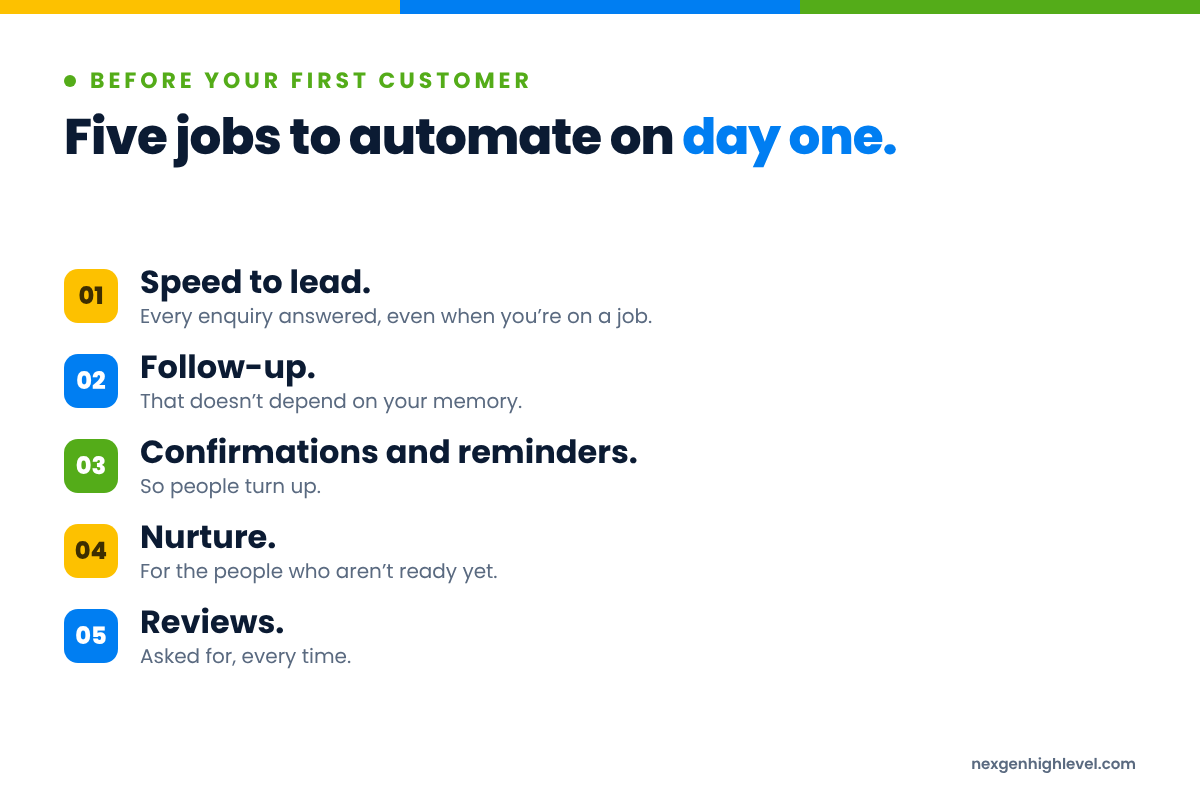
1. Speed to lead
When someone gets in touch, how long do they wait to hear back?
Be honest. Not on your best day. On a normal Wednesday when you're halfway up a ladder.
There's a well-known study on this, and I want to be careful with it. In 2007, InsideSales.com and a researcher then at MIT Sloan published the Lead Response Management Study. It reported that the odds of contacting a lead within 5 minutes, versus 30 minutes, dropped by 100 times. It's a dramatic number, and it gets quoted everywhere.
But it was a vendor co-authored summary presented at a marketing summit, not a peer-reviewed paper, and it doesn't show its sample or method. So I wouldn't build a business plan on the exact figure.
The direction, though, matches everything I've seen in business. When some of the same researchers wrote about online leads in Harvard Business Review in 2011, their summary was blunt: "Our research shows that most companies are not responding nearly fast enough."
Here's the thing about a new business. You're not competing on brand yet. Nobody knows you. But you can compete on speed from the very first day, because speed doesn't need a reputation. It needs a system.
In HighLevel, that might be a workflow that sends a friendly, honest message the moment a form comes in, books them straight onto a calendar if they want, and alerts you so a real person follows up. Not a fake "personal" reply. A clear one: "Thanks, we've got your message, here's what happens next."
Fast and honest beats slow and perfect.
2. Follow-up that doesn't depend on your memory
Most quotes aren't lost. They're abandoned.
Someone asks for a price. You send it. They don't reply. You assume they've gone elsewhere, or you mean to chase but don't, and three weeks later it feels awkward.
Meanwhile, they were waiting for their partner to look at it, or had a question they didn't want to ask.
This was the whole job when I was in recruitment. No email, no CRM, no computer on the desk. A telephone, a filing cabinet and a phone directory. The people who did well weren't the ones with the best patter. They were the ones who followed up, and followed up again, and kept notes on every card so they knew what to say when they did.
A follow-up sequence in HighLevel is just that filing cabinet, with a better memory than mine. A quote goes out, a tag goes on, and the workflow checks in at sensible intervals. When they reply, it stops. When they say yes, the opportunity moves along the pipeline. When they go quiet, it can hand them to you to pick up the phone.
The point isn't to badger people. It's to make sure nobody is left wondering whether you still want the work.
3. Confirmations and reminders
This one is so simple people skip it.
Someone books a time with you. Then life happens. They forget, double-book, or just lose their nerve.
In my agency days, a lot of our clients were US private medical practices. We learned the hard way that bookings mean very little on their own. A full calendar with a stack of no-shows and cancellations isn't a busy business. It's a frustrating one.
HighLevel calendars can send confirmations when someone books and reminders before the appointment, by email and text. Add a simple way to reschedule rather than just vanish, and you've turned a no-show into a different day.
It costs you nothing to set up on day one. It costs you a lot not to.
4. Nurture for the people who aren't ready yet
Not everyone who gets in touch is ready to buy this week. Most aren't.
Some are comparing. Some are saving. Some just aren't sure yet whether they trust you, which is fair, because they've never heard of you.
If your only move is "buy now or goodbye", you lose all of them.
Nurture is how you stay useful in the meantime. A short sequence of emails and texts that actually helps: answers to the questions people always ask, what to expect, a bit about how you work, a reason to come back when the time is right.
For a lawn care business, that might be seasonal reminders. For a credit repair business, it might be explaining the process step by step, so people stop being nervous about it. For an HVAC company, it might be servicing reminders before the weather turns.
Customers don't live inside one channel, and they don't buy on your timetable. Nurture means you're still there when they're ready.
5. Reviews
When you're new, you have no track record. Nobody's heard of you. So what do people check?
Reviews.
Every happy customer in your first year is gold, and many would leave a review if someone asked at the right moment. Trouble is, that moment is usually when you're packing up or already on the way to the next job.
HighLevel's reputation management can send review requests automatically when a job is marked done or a payment comes in. You can also check in first, so unhappy customers come to you to sort things out rather than straight to the internet.
The first fifty reviews do more for a new business than almost anything you could spend money on. Don't leave them to memory.
Human, Strategy, Leverage for a new business
Now for the warning. Because if you take one thing from this article, I'd rather it was this than any workflow.
I use a simple framework for everything we build. Human, Strategy, Leverage. In that order.
- Human. Start with the person. Who is your customer? What do they want? What frustrates them, scares them, stops them acting?
- Strategy. Then decide how you'll help and how you'll say it. The offer, the message, the journey from "never heard of you" to "happy customer".
- Leverage. Only then does technology come in. Automation, AI, workflows, CRM.
Leverage multiplies whatever is underneath it.
That's the bit people miss. Automation doesn't make a business good. It makes a business more of whatever it already is.
Put it behind a clear offer, an honest message and a decent understanding of your customer, and it helps you serve more of them, faster, more consistently.
Put it behind a confused offer and a message nobody understands, and you've found a very efficient way of confusing more people.
If you multiply zero by a thousand, you've still got zero.
The clinic that wouldn't make content
Here's where I learned this properly.
My agency was technically very good. Ads, funnels, follow-up, CRM, the lot. And a lot of our clients were doctors, clinicians and practice owners.
We kept hitting the same wall. They wouldn't supply content. We'd get nothing, or two stock photos and a 14-second video filmed from what looked like six miles away.
We could have automated more around it. More emails, more ads, more sequences. It wouldn't have fixed anything, because the problem wasn't technical.
They hadn't gone into healthcare to be content creators. Put a camera in front of them and they froze.
So we built an app with prompts that removed the blank page and the fear of the camera. And it worked, because we weren't really solving a content-production problem. We were solving a human-friction problem.
That's Human, Strategy, Leverage in one story. We understood the person first, worked out what would actually help, and only then used technology to do it.
Don't use technology to avoid understanding people. Use technology because you understand people.
What this means on day one
You don't need Human and Strategy perfect before you open. You need them good enough, and honest.
Before you build a single workflow, ask yourself:
- Who is my customer, really? Not "anyone who needs X".
- What's the one thing they want to know before they'll trust me?
- What makes them nervous about buying something like this?
- What happens, step by step, between their first enquiry and paying me?
- Where in that journey would I lose someone if I forgot to do something?
That last question is your automation plan. Everywhere you'd lose someone through forgetting is a place a workflow should be doing the remembering.
What you should never automate
There's a version of automation that makes me wince. The text that says "Hey {first_name}!" because the field was empty. The chatbot that can't answer the one question you actually asked.
People buy from people. That was true when I was doing deals face to face in recruitment, and it's true now.
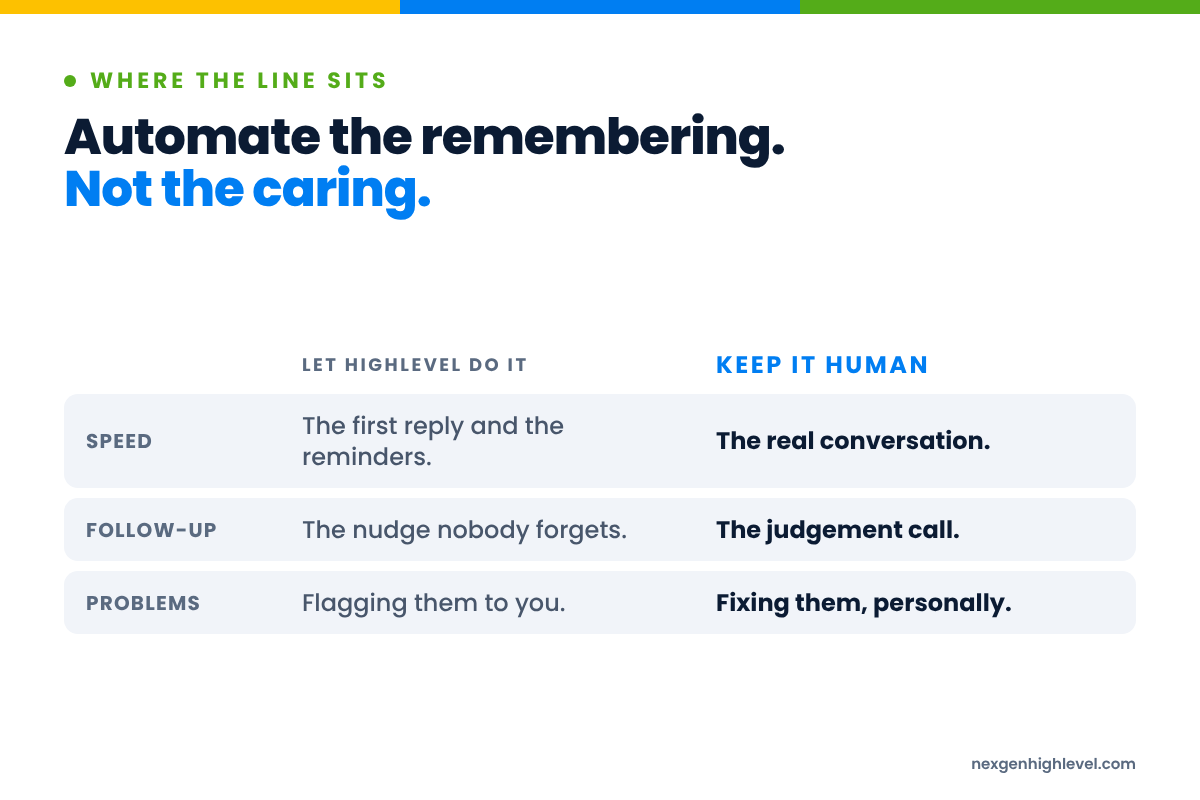
So here's how I'd draw the line.
| Let automation handle it | Keep a human on it |
|---|---|
| The first "we've got your message" reply | The actual conversation about what they need |
| Appointment confirmations and reminders | The appointment itself |
| Quote follow-up nudges | Answering a real objection or a tricky question |
| Nurture emails for people not ready yet | A personal call when someone goes cold after showing real interest |
| Review requests after a job | Handling a complaint or an unhappy customer |
| Alerts and tasks for your team | Judgement calls, pricing exceptions, saying no |
Automation should hand people to a human at the moments that matter. It shouldn't stand between you and your customer.
How new owners get automation wrong
I think people get stuck in business because of personality, not because of which industry they're in. And with automation, I see three personalities over and over again. I see all three in myself, depending on the day.
The Tinkerer
The Tinkerer loves the tools. They build a workflow, then rebuild it, then add a branch for a scenario that has happened precisely never.
Six weeks later the automation is beautiful, and still not live. Meanwhile real enquiries have been sitting in an inbox.
If this is you, I've been there. Done is better than perfect, especially for the boring jobs. A simple reminder that runs today beats an elegant system that runs next quarter. And if putting things off is your real problem, I've written about what procrastination actually costs a business.
The Rusher
The Rusher wants to be live by Friday. They switch everything on untested, and the first customer gets three welcome emails and a review request before the job's even started.
Speed is good. Speed with no checking is just making mistakes faster.
The Magic-Bullet Believer
The Magic-Bullet Believer thinks the software is the answer, and moves on to the next thing when it doesn't fix the business by the weekend.
We see this. Some people install an app and uninstall it the next day. Go figure.
No tool fixes a business on its own. Not ours, not anyone's.
The cure is the same for all three
Know your goal, plan properly, set up properly, understand properly. Then go for it.
Notice that "plan properly" isn't "plan forever", and "go for it" is in there. Six weeks to find out beats six months of wondering.
Starting with a HighLevel Snapshot instead of a blank account
So far I've talked about what to automate. Now let's talk about the part nobody warns you about: building it.
When you open a fresh HighLevel account, it's an empty workshop. Every tool is there. Nothing is built.
And building it yourself is where a lot of new owners lose months.
Not because any single piece is hard. Because the pieces have to connect.
The form has to feed the right fields. The fields have to trigger the right workflow. The workflow has to send the right messages, tag the contact, create the opportunity in the right pipeline stage, and book the calendar. The calendar has to send the confirmations and reminders. When the job's done, the review request has to go out. And the reporting has to show you what actually turned into revenue.
Every connection is a decision. And every decision made in a hurry is a chance for something to quietly break.
What a Snapshot actually is
A Snapshot is HighLevel's way of packaging a whole account setup so it can be loaded into another account.
At NexGenHighLevel, we use that to build what I'd call a business system in a box for a particular niche. Funnels, forms, workflows, pipelines, calendars, emails and texts, AI features, all already built and already connected around the whole client journey, from first enquiry to happy customer to review.
So on day one, you're not staring at an empty workshop. You're starting from a working system and making it yours: your name, your offer, your voice, your prices, your way of doing things.
I've gone into more detail in what a HighLevel Snapshot really is, but the important bit here is simple.
With a Snapshot, the automation is already built and connected. The five jobs in this article aren't on a to-do list. They're there.
Building it yourself vs starting from a Snapshot
Here's the honest comparison as I see it.
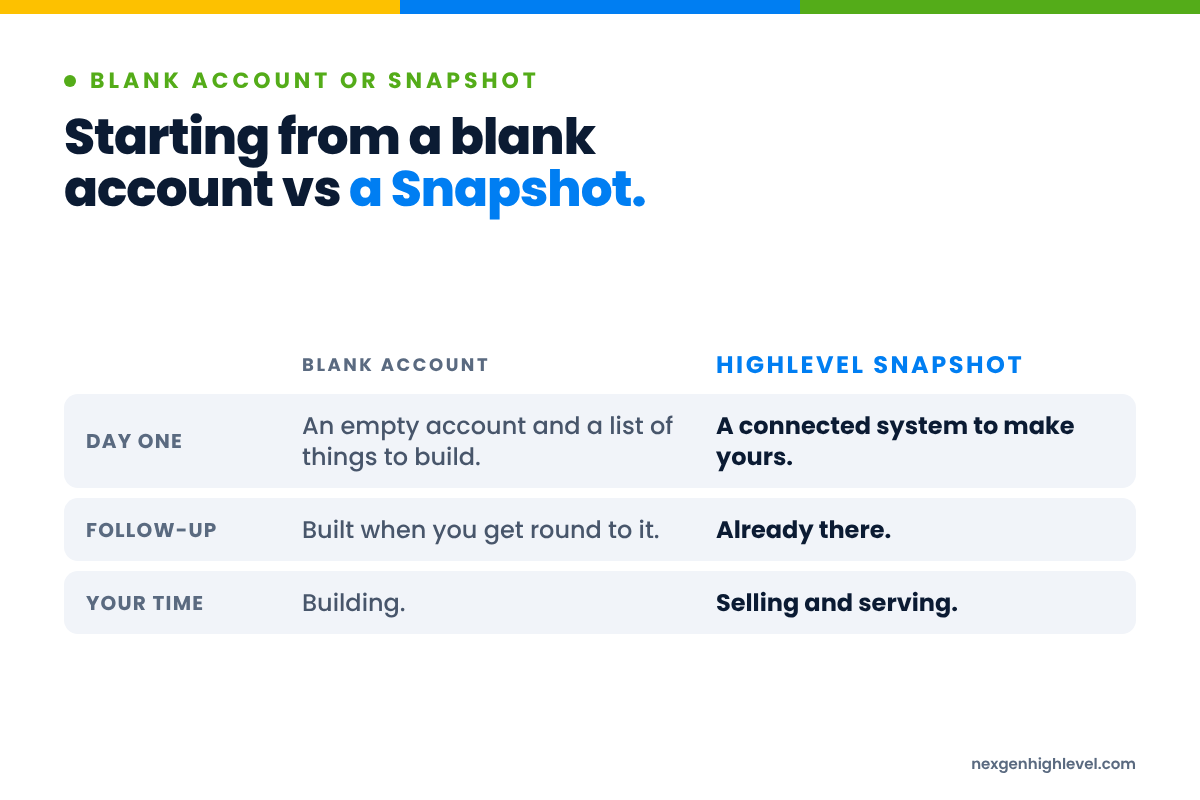
| Building from a blank account | Starting from a Snapshot | |
|---|---|---|
| Where you start | An empty account and a list of ideas | A working system, connected end to end |
| Time to first useful automation | However long it takes you to learn, build and test | As soon as you've made it yours |
| The connections between pieces | Yours to design and debug | Already joined up around the client journey |
| Your effort goes into | Building the machine | Your offer, your customers and the work |
| Still your job | Everything | Your offer, understanding your customer, doing the work |
Clients have used Snapshots to skip months, if not years, of trial and error building a system. That's the real value. Not a shortcut round the work, but a shortcut round the building, so your time goes into the parts only you can do.
For the business owner and for the agency
Snapshots aren't only for business owners.
Some are built for a niche business running HighLevel itself. Our Landscaping and Lawn Care Snapshot, for example, or the HVAC and Credit Repair ones. They suit the owner who wants control, and equally the agency that serves that niche and wants to deliver a proper system for every client rather than rebuilding it each time.
And one is built for agencies themselves. The SMMA Snapshot is the system for running a social media marketing agency: winning clients, onboarding them, delivering and keeping them.
We're building more niches. If you want to see what exists today, the HighLevel Snapshots page will point you to the system built for your type of business.
A Snapshot is not magic
I want to be really clear here, because this is where the Magic-Bullet Believer gets excited.
A Snapshot is leverage. It's the third word in Human, Strategy, Leverage. It doesn't replace the first two.
You still need a good offer. You still need to understand your customer. You still need to make the messages sound like you, answer the phone, do great work and ask for the review.
What it removes is the months of building, guessing and fixing before any of that can start working for you.
It's not a business. It's the system a business runs on.
A day-one automation checklist for HighLevel
Whether you build it or start from a Snapshot, here's what I'd want true before the first enquiry lands. Questions, not a manual.
Capture
- Does every way someone can reach you (form, calendar, phone, message) end up in one place, as a Contact?
- Do you know where each person came from?
Respond
- Does every new enquiry get an honest, immediate reply that tells them what happens next?
- Does a real person get alerted to follow up?
Book
- Can people book a time without three emails back and forth?
- Do confirmations and reminders go out without you thinking about it?
Follow up
- Does every quote get followed up, even on the week you're flat out?
- Does the follow-up stop the moment they reply?
Review
- Does every finished job trigger a review request?
- Is there a way for an unhappy customer to reach you first?
Measure
- Can you see which enquiries became paying customers, not just bookings?
- Do you know which source brought in revenue and profit, not just clicks?
That last section matters more than it looks. Bookings mean very little if they don't turn into revenue. Clicks mean even less. From day one, judge your automation by whether it helps you make money, not by how busy it looks.
If you haven't got an account yet, you can create a HighLevel account through NexGenHighLevel and start there.
Walk before you run, but walk from day one
I'll finish this section with something personal.
When I grew my recruitment business, I grew it the way you did back then. More people, more desks, more overheads. Grow hard and fast.
Then Covid arrived. Furlough covered salaries, but not the rent, the property taxes, the leases or the software licences, and no supplier cut us a break. I had to close the business and make the team redundant. The hardest business decision of my life.
Automation wouldn't have saved it. But it taught me something I've carried ever since. Walk before you run. And even when you're ready to run, keep walking for a little bit longer.
For a new business, automation is how you walk properly. It lets you look after customers well without taking on overheads before you can see the green field stretching out in front of you.
Frequently asked questions
Is marketing automation worth it for a small business just starting out?
I think it's worth it most when you're just starting. In your first year every enquiry costs real money and effort to find, and you're doing everything yourself, so follow-up is the first thing to slip. Automation handles the repeatable jobs: replies, reminders, follow-up, review requests. It doesn't replace you. It makes sure the customers you've already found don't quietly drift away while you're busy doing the work.
What should a new business automate first?
Start with the jobs that lose you customers when they're forgotten. Reply to every new enquiry quickly and honestly. Confirm and remind every appointment. Follow up every quote. Keep in touch with people who aren't ready yet. Ask every happy customer for a review. None of it is clever, and that's the point. Get those five running consistently before you build anything fancier.
Will automation make my business feel impersonal?
Only if you automate the wrong things. Let automation handle the admin: confirmations, reminders, nudges and alerts. Keep people on the conversations that matter, like understanding what someone needs, handling objections and sorting out complaints. Write your messages the way you'd actually speak. Good automation should hand customers to a human at the right moments, not hide you from them. People buy from people.
How long does it take to set up marketing automation in HighLevel?
It depends on where you start. Building from an empty HighLevel account, you're designing every form, workflow, pipeline and calendar and connecting them yourself, which can take a long time to get right. Starting from a Snapshot, the system is already built and connected, so your time goes into making it yours. Either way, get the essential jobs live first, then improve.
Do I need a Snapshot to use automation in HighLevel?
No. Everything in a Snapshot can be built by hand in HighLevel, and some people enjoy doing it. The question is where you want your time to go. A Snapshot gives you a complete, connected system for your niche, so you're not spending months building and testing. Either way, you still need a good offer and a real understanding of your customer. A Snapshot is leverage, not a strategy.
Can automation help me respond to leads faster?
Yes, and for a new business it's one of the easiest wins. A workflow can reply the moment someone fills in a form, offer them a time on your calendar and alert you to follow up personally. You might not be able to compete with bigger businesses on reputation yet, but you can compete on speed from day one. Speed doesn't need a brand. It needs a system.
Day one, not year three
Starting a business takes courage. Growing a business takes systems. Most people have the courage and leave the systems for later.
I'd turn that round.
On day one, nobody knows who you are. You can't out-spend the big players, and you can't out-brand them. But you can reply faster. You can follow up every time. You can remind people, look after people, and ask happy customers to say so.
Those aren't big-company luxuries. They're the habits that give a new business a fair chance.
Get the human part right. Get the strategy right. Then let the technology do the remembering, so you can do the work only you can do.
Your business is only as good as the follow-up you forgot.